The Ever-Changing Crust: Earth as a Planetary Recycling Kiln
Pick up a smooth river pebble or a rough chunk of granite from your backyard. It feels cold, dense, and permanent. In everyday human experience, stone is the ultimate symbol of durability. Yet in geological time, every rock on Earth is in a state of continuous, slow-motion reinvention.
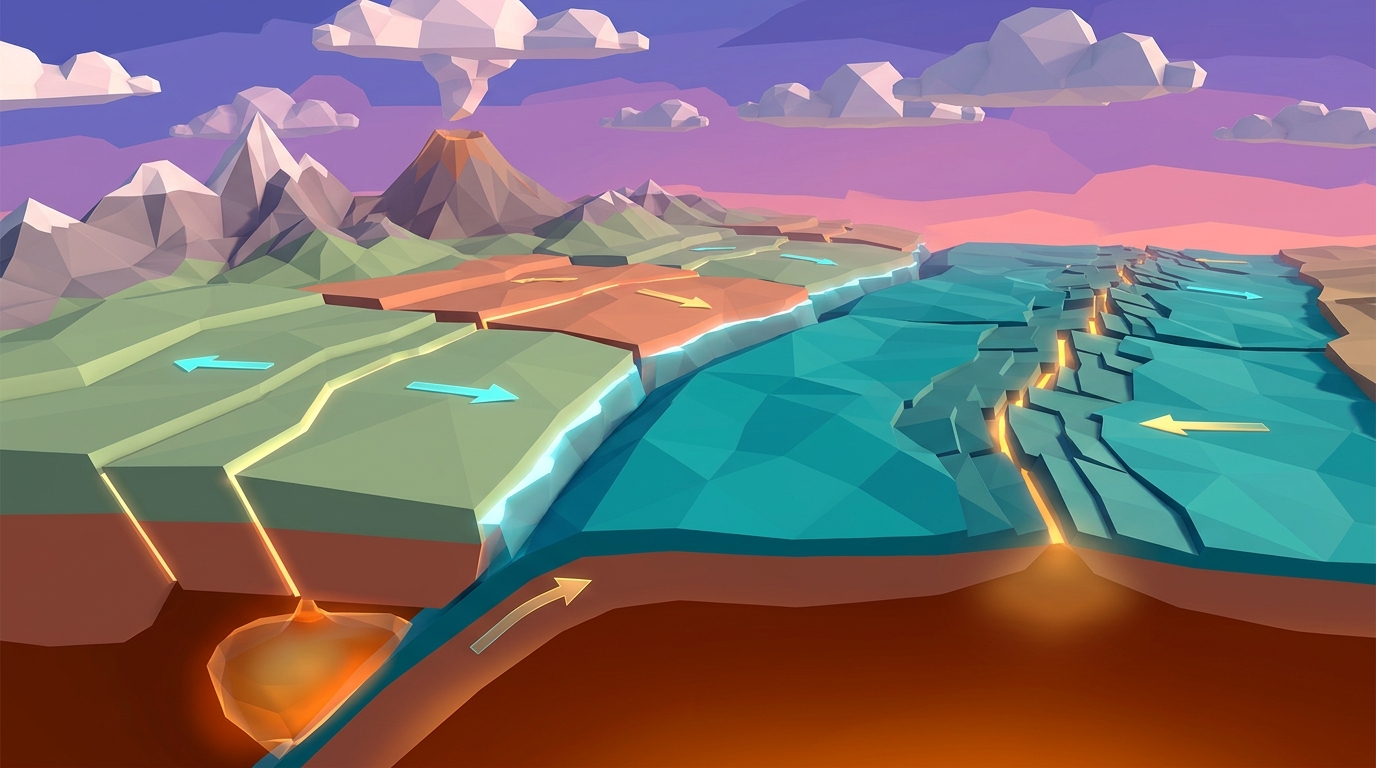
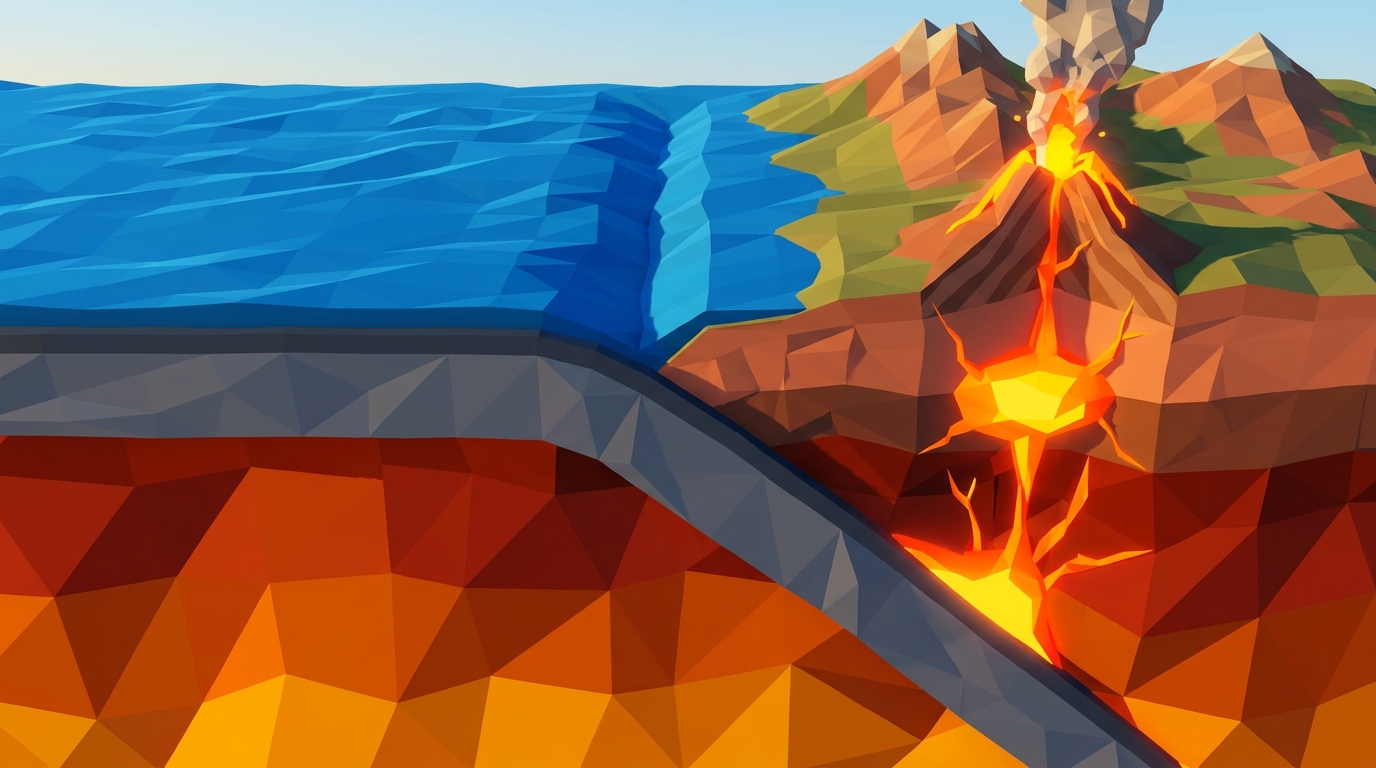
Earth's outer crust is not a stationary museum; it is a giant planetary recycling kiln. Driven by two opposing energy engines: the scorching radioactive heat of Earth's core and the solar-driven weather cycles of our atmosphere, rocks are constantly melted, crystallized, crushed, eroded, buried, and re-cooked.
Think of the rock cycle like a commercial kitchen recycling station. Imagine fresh cookie dough baked into solid, crispy cookies (igneous rocks). If you leave those cookies outside, rain and wind crumble them into tiny crumbs that collect at the bottom of a jar and get pressed together (sedimentary rocks). If you take those crushed layers and bake them in a heavy press under intense heat without melting them back into liquid dough, they fuse into dense, chewy fudge brownies (metamorphic rocks). And if you crank the oven heat to extreme levels, the whole batch melts back into hot batter (magma), ready to begin again.
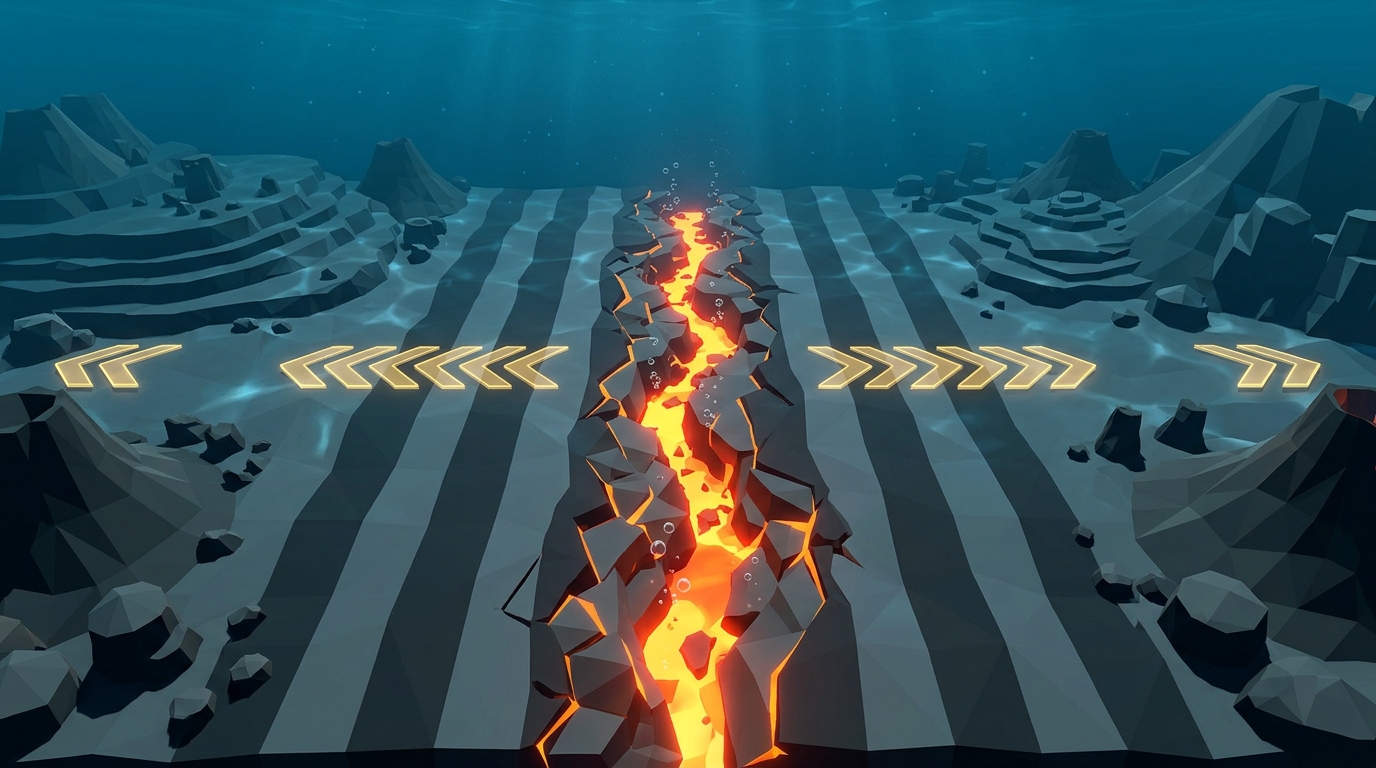
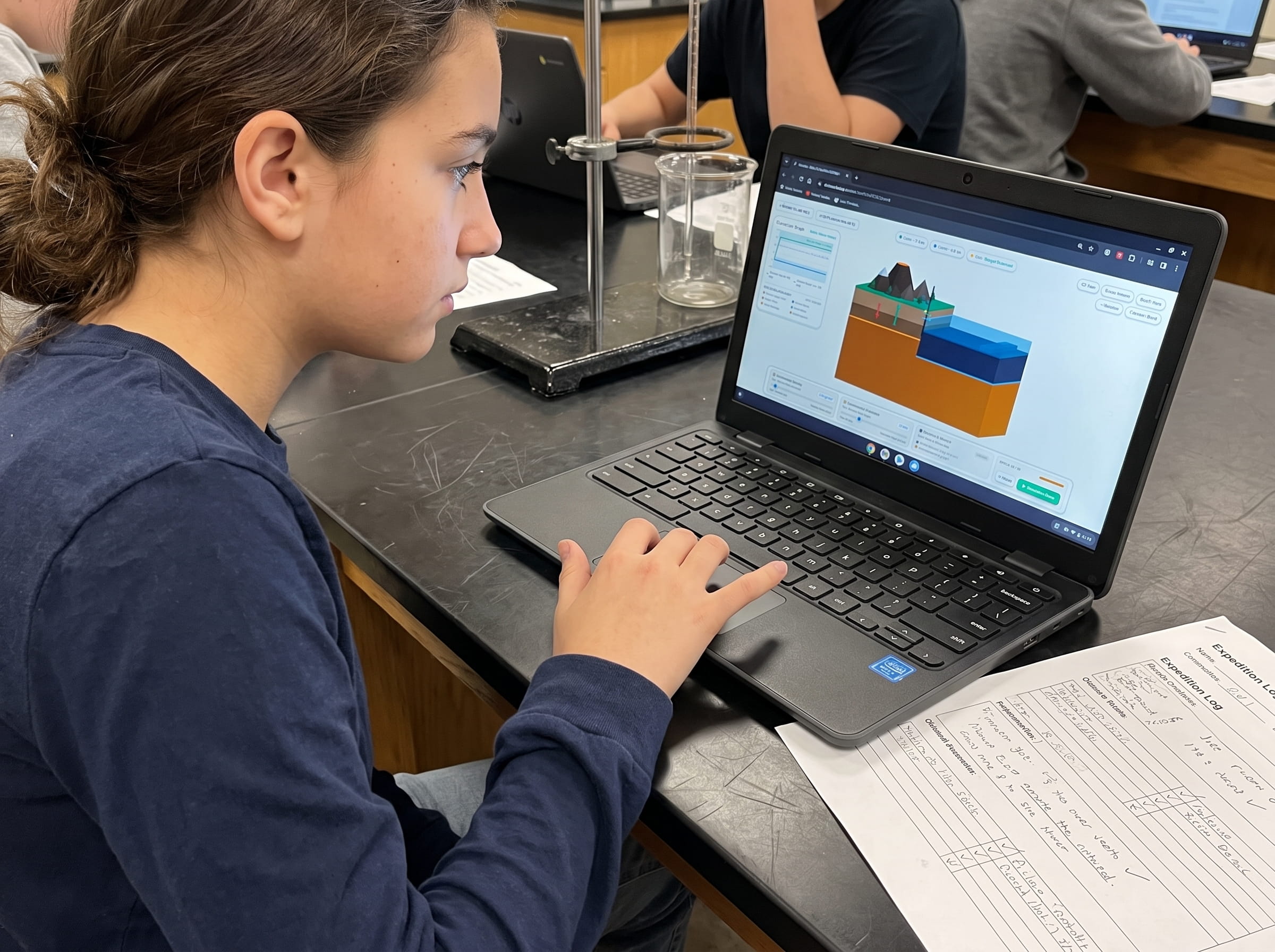
Launch Volcano Island in your browser. Watch basaltic lava crystallize into fresh oceanic crust in Level 1 and trace rock recycling in Level 15 with zero account creation.
Launch Free 3D Rock Cycle SandboxThe Three Great Rock Families: Origins, Physics, and Textures
All rocks across our planet belong to one of three foundational families, classified by how they formed:
1. Igneous Rocks (Born of Fire): Igneous rocks form when molten rock cools and solidifies into crystalline mineral lattices. When magma cools slowly deep underground over hundreds of thousands of years, large visible mineral grains have time to grow, producing coarse-grained intrusive rocks like granite and gabbro. When lava erupts onto the cold surface and quenches rapidly within seconds or days, crystals remain microscopic or form volcanic glass, producing fine-grained extrusive rocks like basalt, obsidian, and pumice.
2. Sedimentary Rocks (Layers of Time): Sedimentary rocks cover roughly 75 percent of Earth's land surface. They form through a five-step mechanical and chemical sequence: weathering breaks preexisting rocks into mineral grains; erosion and wind or water transport the fragments; deposition settles them into quiet basins like ocean floors or lake beds; compaction squeezes out trapped water under accumulating weight; and cementation precipitates dissolved minerals like calcite and silica between the grains, gluing them into solid stone like sandstone, shale, and limestone.
3. Metamorphic Rocks (Re-Cooked Under Pressure): Metamorphic rocks occur when preexisting igneous, sedimentary, or older metamorphic rocks are subjected to blistering heat (above 200 degrees Celsius) and intense tectonic pressure deep underground without fully melting. Under differential stress, mineral grains rotate and recrystallize into aligned parallel ribbons, creating foliated textures seen in slate, schist, and banded gneiss. When uniform pressure acts on pure minerals, non-foliated rocks like marble (recrystallized limestone) and quartzite (recrystallized quartz sandstone) are forged.
Cooling & Solidification (Igneous Genesis)
Molten silicate magma ascends from the mantle. If trapped underground, it forms coarse plutonic granite; if erupted, it freezes into fine volcanic basalt.
Weathering, Transport, and Lithification (Sedimentary)
Surface exposure exposes rock to rain, ice, and plant acids. Rivers wash silt into ocean deltas, where overburden pressure cements loose grains into sandstone.
Tectonic Burial & Solid-State Recrystallization (Metamorphic)
Plate collisions shove sedimentary shale miles underground. Extreme directional stress realigns clay minerals into gleaming mica sheets, transforming shale into schist.
In Level 15 of Volcano Island, adjust burial depth, lithospheric pressure, and geothermal gradient to observe how shale converts into slate, schist, and gneiss before melting.
Test Pressure & Heat in Level 15The Secret Shortcut Pathways: Why the Rock Cycle is a Web, Not a Circle
Many introductory science textbooks present the rock cycle as a clean, orderly circle: Igneous rocks always become Sedimentary rocks, which always become Metamorphic rocks, which always melt into Magma. In nature, this is a major oversimplification.
The rock cycle is not a closed single-lane roundabout; it is an open, interconnected transit web with multiple express shortcuts:
Shortcut 1 (Igneous Directly to Metamorphic): When continental plates collide, granite plutons deep underground are directly sheared and squeezed into gneiss without ever being weathered or deposited as surface sediment.
Shortcut 2 (Sedimentary Directly to Sedimentary): Sandstone exposed on a desert cliff can weather directly into loose sand dunes, which blow into a canyon and cement back into new sandstone, bypassing the metamorphic and igneous stages completely.
Shortcut 3 (Metamorphic Directly to Sedimentary): Mountain uplift can push deep metamorphic schist directly to the surface, where alpine glaciers grind it into rock flour that washes into mountain lakes to form new shale.
Every rock family can transform directly into any other family, or even back into itself, depending on which geological forces it encounters.
In your printed Field Geologist Logbook, trace three alternative shortcut pathways for a single atom of silicon starting in an oceanic basalt slab and ending in a quartzite arrowhead.
Follow a Mineral Crystal Through the Rock Cycle in 3D
Track mineral grains as they erupt from magma chambers, wash down river canyons into sedimentary strata, and plunge into subduction kilns in our real-time 3D Earth science simulation.
Teaching this topic tomorrow? Download the Free NGSS Student Lab Sheet (Printable PDF)
A printable 24-page Earth Science Student Journal featuring rock cycle pathway flowcharts, rock classification dichotomous keys, and mineral crystal inspection sheets calibrated for middle school classrooms.
The Dual Energy Engines: What Keeps the Rock Cycle Moving?
If you leave a glass of water on a table in a sealed room, nothing moves. For billions of tons of planetary rock to continuously transform, Earth requires immense power sources. The rock cycle is driven by two independent, opposing energy engines:
1. The External Heat Engine (Solar Radiation & Gravity): The Sun heats Earth's atmosphere and oceans, fueling the hydrological cycle. Evaporation creates rain, snow, and rivers that relentlessly weather and erode elevated continents. Combined with gravity, which pulls weathered debris downhill toward oceanic basins, the solar engine acts as Earth's planetary demolition crew.
2. The Internal Heat Engine (Geothermal Energy & Radioactivity): Deep inside Earth, the decay of radioactive isotopes (uranium, thorium, potassium) and primordial heat left over from planetary accretion create temperatures exceeding 5,000 degrees Celsius. This subterranean furnace drives mantle convection currents, plate collisions, volcanic eruptions, and crustal uplift, acting as Earth's planetary construction crew.
Without plate tectonics to push rocks back up, solar erosion would have flattened all continents into sea-level plains within a few hundred million years. Without weather to break rocks down, volcanic terrain would cover the world in barren lava without fertile soil. The interplay of both engines makes Earth a living, dynamic world.
In Volcano Island, balance surface erosion rates against tectonic volcanic uplift to discover how long a newly formed volcanic archipelago survives before wave action erodes it back into an underwater seamount.
Anatomy of the Three Rock Types: Comparative Identification Matrix
Use this classroom-ready diagnostic guide to differentiate between the three rock families by formation environment, cooling rate, visual textures, and classic mineral examples:
| Rock Family | Geological Formation Environment | Defining Visual Textures | Diagnostic Physical Features | Classic Rock Examples |
| :--- | :--- | :--- | :--- | :--- |
| Igneous (Intrusive) | Slow cooling deep beneath surface within magma plutons | Coarse-grained (phaneritic), interlocking mineral crystals | High density, visible quartz/feldspar grains, no layering | Granite, Diorite, Gabbro, Peridotite |
| Igneous (Extrusive) | Rapid cooling on surface or underwater from lava flows | Fine-grained (aphanitic), glassy, or vesicular gas bubbles | Microscopic crystals, porous holes, dark or glassy sheen | Basalt, Obsidian, Pumice, Rhyolite |
| Sedimentary (Clastic) | Mechanical weathering, river transport, and basin compaction | Layered (stratified), granular sand/pebble grains | Visible sediment beds, sandstone grit, presence of fossils | Sandstone, Shale, Conglomerate, Siltstone |
| Sedimentary (Chemical/Organic) | Mineral precipitation or accumulation of organic shell debris | Fine crystalline matrix or compacted biological matter | Reacts with mild acid (calcite), fossil shell fragments | Limestone, Chert, Rock Salt, Coal |
| Metamorphic (Foliated) | Directed tectonic pressure and heat during mountain building | Banded ribbons, platy alignment of mica flakes | Wavy striped layers, split along cleavage planes | Slate, Phyllite, Schist, Gneiss |
| Metamorphic (Non-Foliated) | Uniform confining pressure and contact thermal baking | Granular, sugary interlocking recrystallized grains | Dense, durable, uniform color, no directional banding | Marble, Quartzite, Hornfels, Anthracite |
Frequently Asked Questions About the Rock Cycle
Direct, curriculum-aligned answers to common questions middle school teachers, students, and homeschool parents ask about the rock cycle and mineral transformations.
Can an igneous rock turn directly into a metamorphic rock without eroding first?
What is the difference between magma and lava?
Why are fossils almost exclusively found in sedimentary rocks?
How long does a complete journey through the rock cycle take?
Related Earth Science Guides and Interactive Laboratories
Deepen your middle school Earth science mastery with our companion simulations and educational resources:
Explore how tectonic plates pull apart to create fresh basalt in our divergent ocean boundaries and seafloor spreading guide.
See how colliding plates drag crust back into the mantle in our convergent plate boundary and subduction guide.
Understand crustal buoyancy in our crustal buoyancy and isostasy simulation lab.
Discover why magma thickness changes in our composite volcano silica viscosity simulation explainer.
Explore our complete inquiry-based earth science homeschool curriculum options.
Free 24-Page Field Geologist Expedition Logbook (Printable PDF)
A printable 24-page Earth Science Student Journal featuring rock cycle pathway flowcharts, rock classification dichotomous keys, and mineral crystal inspection sheets calibrated for middle school classrooms.