The Boiling Pot Beneath Our Feet: Earth as a Planetary Heat Engine
When Alfred Wegener presented his groundbreaking hypothesis of continental drift in 1912, the scientific establishment rejected his ideas. Wegener had overwhelming fossil matches and matching mountain belts across oceans, but he could not answer the fundamental physics question: What colossal force on Earth has enough power to shove solid granite continents thousands of miles across the globe?
The answer lay nearly 3,000 kilometers beneath Wegener's boots, hidden in the slow, silent churning of Earth's mantle. Earth is not a cold lump of stone; it is an enormous thermal engine radiating primordial and nuclear heat into the vacuum of space.
Think of a large pot of thick tomato soup heating on a kitchen stove. As the bottom of the pot warms from the burner, the soup near the base expands, becomes less dense, and wells up buoyantly toward the surface. At the open top, the soup radiates its heat into the kitchen air, cools down, forms a thin skin, and sinks back along the cooler walls of the pot. In geophysics, this circulating thermal loop is called convection.
There is, however, one critical distinction between soup and Earth's mantle: the mantle is not liquid magma. With the exception of tiny isolated magma pockets, the mantle is solid crystalline silicate stone (primarily peridotite). Yet under intense geothermal temperatures (1,000 to 3,700 degrees Celsius) and crushing lithostatic pressure, solid rock behaves like ultra-stiff modeling clay over millions of years, deforming through solid-state plastic creep at speeds of 2 to 15 centimeters per year.
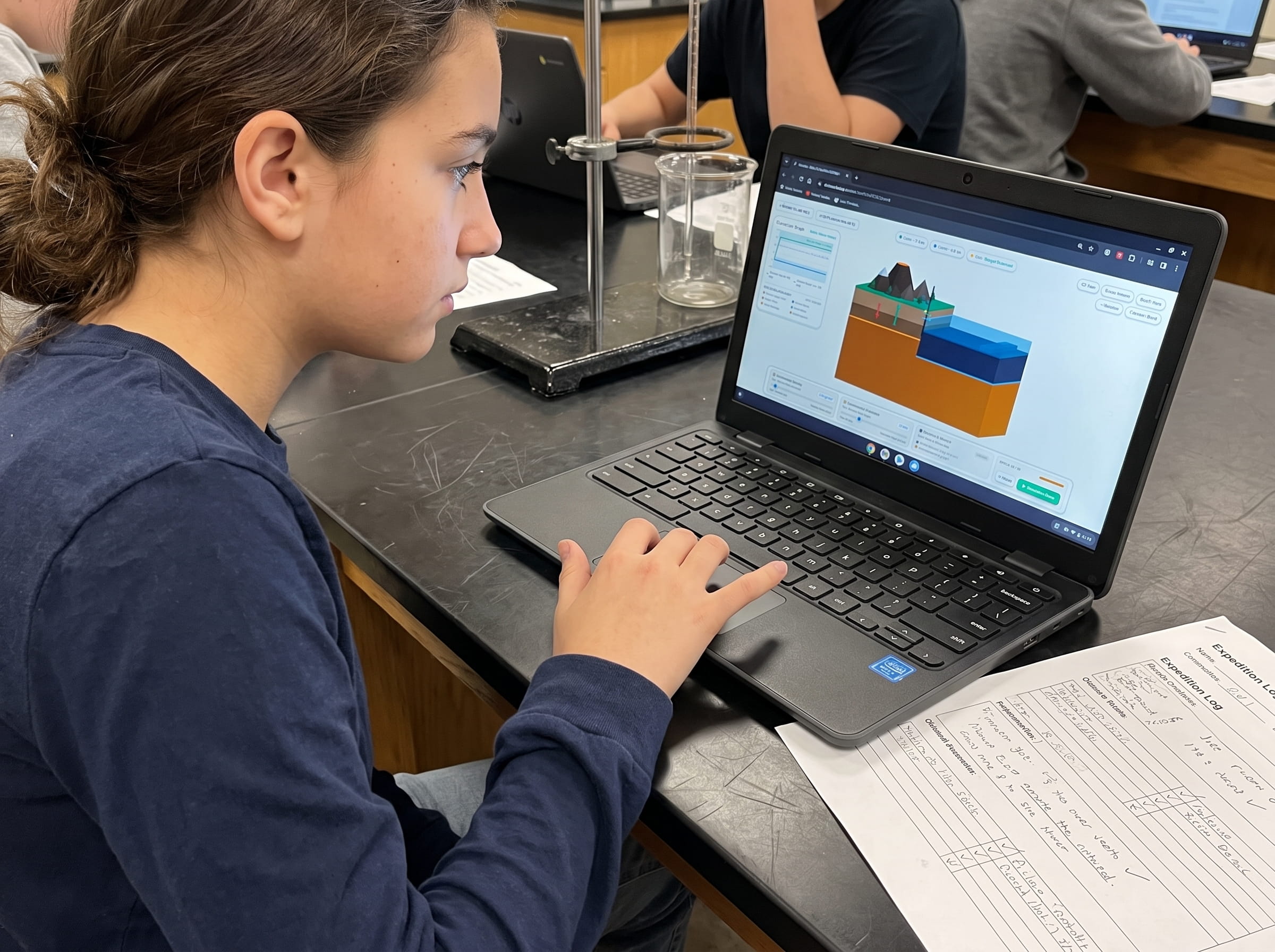
Open Level 2 of Volcano Island directly in your browser. Experiment with core temperature settings and observe how convective loops speed up plate motion with zero logins.
Launch Free 3D Mantle Convection SandboxThe Three Thermal Sources Powering the Convective Engine
For hundreds of millions of cubic kilometers of solid mantle stone to continuously churn, Earth requires an unfathomable energy supply. That heat comes from three distinct geological and cosmological sources:
1. Primordial Heat of Planetary Accretion: Approximately 4.5 billion years ago, countless asteroids, protoplanets, and meteorites collided to assemble the proto-Earth. The kinetic energy of those violent impacts converted into heat, melting the young planet. Because rocky silicate crust is an outstanding thermal insulator, much of that original primordial heat remains trapped in Earth's iron core today.
2. Radiogenic Heat (Radioactive Decay): Deep inside the mantle and crust, unstable radioactive isotopes: predominantly Uranium-238, Uranium-235, Thorium-232, and Potassium-40, continuously decay into stable daughter isotopes. As their atomic nuclei break down, they release subatomic particles that collide with surrounding atoms, generating steady radiogenic heat that accounts for roughly half of Earth's internal thermal budget.
3. Core Crystallization (Latent Heat of Fusion): Earth's metallic core is divided into a liquid nickel-iron outer core and a solid inner core. As the planet gradually cools, molten iron at the inner core boundary slowly crystallizes into solid metal. This phase transition releases latent heat, which warms the base of the mantle and invigorates rising convection plumes.
Core-Mantle Boundary Heat Exchange (The D" Layer)
At the base of the mantle 2,900 km deep, intense thermal energy conducts from the 5,000 C molten iron outer core into the cooler base of the silicate mantle.
Buoyant Thermal Plume Ascent
Because warmer rock is less dense than the surrounding cold mantle, massive thermal plumes rise upward like slow-motion hot air balloons over tens of millions of years.
Lateral Basal Drag and Cold Slab Descent
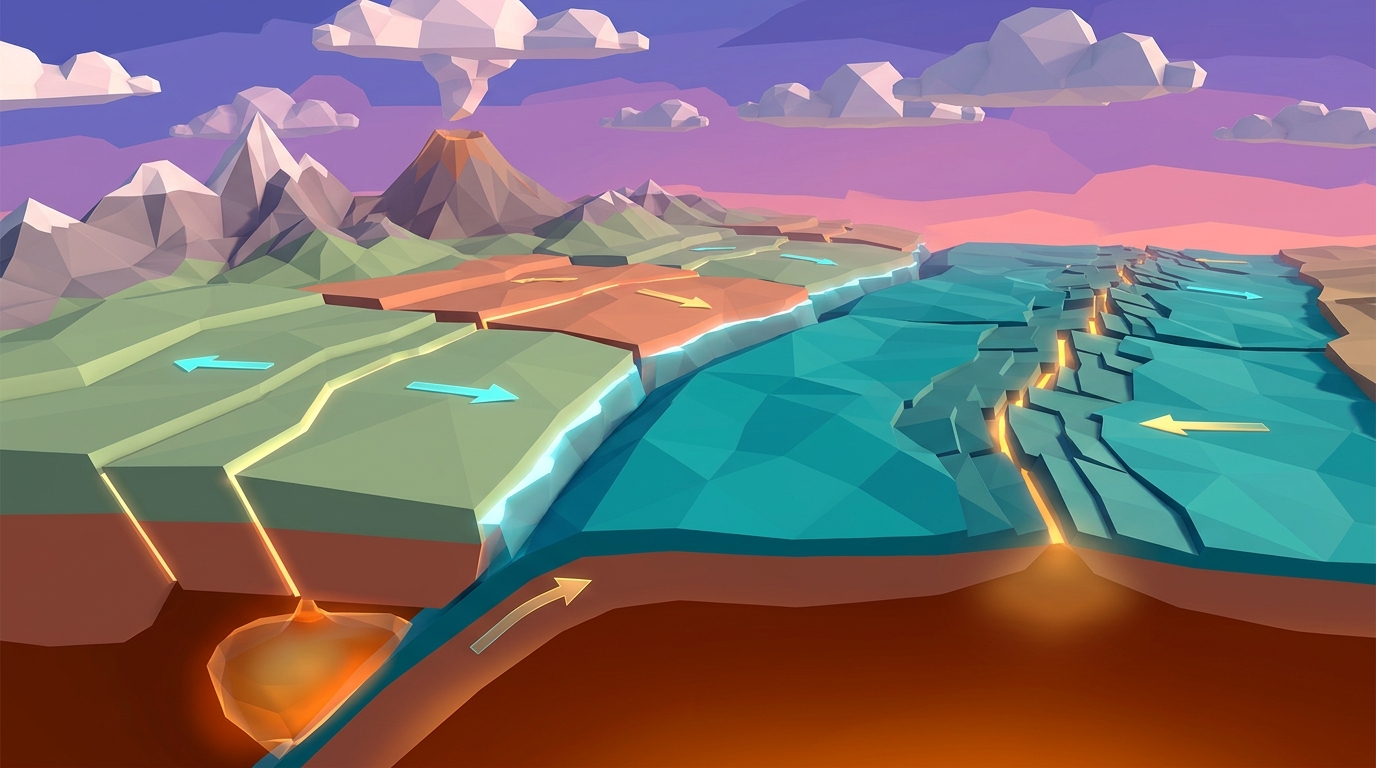
Upon reaching the base of the lithosphere, ascending plumes deflect horizontally, exerting frictional basal traction that pulls plates apart before cooling and sinking back down at subduction zones.
In Level 2 of Volcano Island, adjust the Core Thermal Output dial and watch how thermal convection loops speed up, causing mid-ocean ridges to widen and spreading rates to double.
Test Core Temperatures in Level 2The Three Driving Forces of Plate Tectonics: Traction, Push, and Pull
While early geologists pictured tectonic plates riding passively atop mantle conveyor belts like suitcases on an airport carousel, modern geophysics reveals that plate motion is driven by a cooperative mechanical trinity:
1. Basal Drag (Mantle Traction): As the asthenosphere circulates horizontally beneath the rigid lithospheric plates, friction between the ductile flowing mantle and the underside of the crust exerts a shear drag force. While basal drag was once thought to be the sole mover, calculations show it acts more like a moderating stabilizer than the main engine.
2. Ridge Push (Gravitational Sliding): At mid-ocean ridges, buoyant upwelling mantle raises the seafloor into elevated mountain ridges standing 2 to 3 kilometers above abyssal ocean plains. Because these ridges are high and hot, gravity pulls the newly formed oceanic crust downhill away from the ridge crest, producing a lateral compressive push across the ocean basin.
3. Slab Pull (Gravitational Subduction Sinking): As oceanic crust ages over 50 to 100 million years, it cools, thickens, and becomes denser than the warm asthenosphere beneath it. When it plunges into a subduction trench, high-pressure metamorphism converts basalt into ultra-heavy eclogite. This dense slab acts as an enormous gravitational anchor, pulling thousands of miles of trailing seafloor down with it. Geophysicists estimate that slab pull provides up to 90 percent of the total net driving force of plate motion.
In your printed Field Geologist Logbook, resolve the three force vectors (basal drag, ridge push, slab pull) for the Pacific Plate. Calculate why the Pacific Plate moves three times faster than the Atlantic Plate.
Control Mantle Heat Gradients & Model Convection in 3D
Calibrate core-mantle boundary temperatures, adjust rock viscosity, and watch real-time convection cells drag lithospheric plates across the globe in our browser-based 3D physics diorama.
Teaching this topic tomorrow? Download the Free NGSS Student Lab Sheet (Printable PDF)
A printable 24-page Earth Science Student Journal featuring mantle convection cell schematics, thermal gradient graphing grids, and plate tectonic driving force calculation sheets designed for middle school classrooms.
Whole-Mantle vs. Layered Convection: The Great Geophysical Debate
For decades, seismologists and geochemists debated how mantle convection operates: Does the entire mantle circulate in one unified loop, or is it divided into two independent, stacked layers?
The Layered Convection Model proposed that the upper mantle (down to 660 kilometers) and the lower mantle circulate separately. At 660 kilometers deep, crushing pressure forces the mineral ringwoodite to collapse into a much denser perovskite crystal structure (bridgmanite). Some scientists theorized that this density discontinuity acted as an impenetrable barrier, trapping subducting slabs in the upper mantle.
However, modern seismic tomography: using seismic earthquake waves like an ultrasound to image Earth's interior, has settled the debate in favor of Whole-Mantle Convection. High-resolution tomographic scans clearly show cold, dense subducted slabs slicing straight through the 660-kilometer boundary, plunging all the way down to the core-mantle boundary (the D" layer), while giant superplumes rise directly from the core to feed volcanic hotspots like Hawaii and Iceland.
In Volcano Island, switch the Convection Model toggle between Layered and Whole-Mantle mode and observe how subducting slab penetration depth fundamentally alters surface plate speeds and hotspot volcanic stability.
Comparative Matrix of Tectonic Driving Forces
Use this diagnostic reference to understand the mechanical mechanisms, energy sources, primary locations, and relative force contributions of the three plate tectonic driving forces:
| Tectonic Driving Force | Mechanical Mechanism | Primary Energy Source | Geological Location | Relative Force Contribution | Modern Global Example |
| :--- | :--- | :--- | :--- | :--- | :--- |
| Slab Pull | Negative buoyancy of dense, cold oceanic slab sinking into mantle | Planetary gravity acting on dense eclogite phase minerals | Convergent subduction zones | Dominant (approx 80% - 90% of net force) | Pacific Plate subducting into Mariana & Japan Trenches |
| Ridge Push | Gravitational sliding of elevated, buoyant ridge downslope | Gravitational potential energy from bathymetric elevation | Divergent mid-ocean ridges | Secondary (approx 10% - 15% of net force) | Mid-Atlantic Ridge pushing North America and Europe apart |
| Basal Drag (Mantle Traction) | Frictional shear coupling between asthenosphere flow and crust | Thermal convection loops driven by core heat and radioactivity | Lithosphere-asthenosphere boundary | Minor / Variable (can either drive or resist motion) | Nazca Plate riding eastward mantle currents toward South America |
Frequently Asked Questions About Mantle Convection Currents
Direct, curriculum-aligned answers to common questions middle school teachers, students, and homeschool parents ask about mantle convection and plate movement.
Is the Earth's mantle liquid or solid?
How fast do mantle convection currents move?
What would happen if Earth's mantle stopped convecting?
What is the D" (D-double-prime) layer?
Related Earth Science Guides and Interactive Laboratories
Continue expanding your Earth and Space science curriculum with our companion interactive guides:
Explore how convective upwelling tears seafloors apart in our divergent ocean boundaries and seafloor spreading guide.
Discover why continents collide and subduct in our convergent plate boundary and subduction guide.
See how rocks melt and transform in our rock cycle interactive middle school guide.
Learn why silica changes magma explosions in our magma silica viscosity and eruption types explainer.
Browse our complete inquiry-based earth science homeschool curriculum options.
Free 24-Page Field Geologist Expedition Logbook (Printable PDF)
A printable 24-page Earth Science Student Journal featuring mantle convection cell schematics, thermal gradient graphing grids, and plate tectonic driving force calculation sheets designed for middle school classrooms.