The Multi-Age Challenge: Why Traditional Science Exhausts Large Families
For homeschool families with two, three, or more children, science is often the first subject to cause parent burnout. Trying to teach 3rd grade biology, 5th grade earth science, and 7th grade physical science simultaneously requires managing three separate curricula, three sets of experiment supplies, and three isolated blocks of teaching time.
The common alternative, teaching to the middle, creates its own frustrations: older middle schoolers feel under-challenged by simplistic crafts, while younger elementary children are confused by dense paragraphs and technical vocabulary.
The family-style solution replaces fragmented curricula with a unified anchor phenomenon. By exploring one rich, multi-variable scientific system together (such as ecosystem population dynamics or energy flow), the entire family learns collaboratively while completing differentiated tasks matched to their individual abilities.
In family-style science, the entire family gathers around one shared phenomenon or digital simulation. Younger children record qualitative visual observations, while older siblings perform quantitative mathematical calculations: all from the same live experiment.
Differentiating by Grade Band: Grades 3, 5, and 8 on the Same Lab Trial
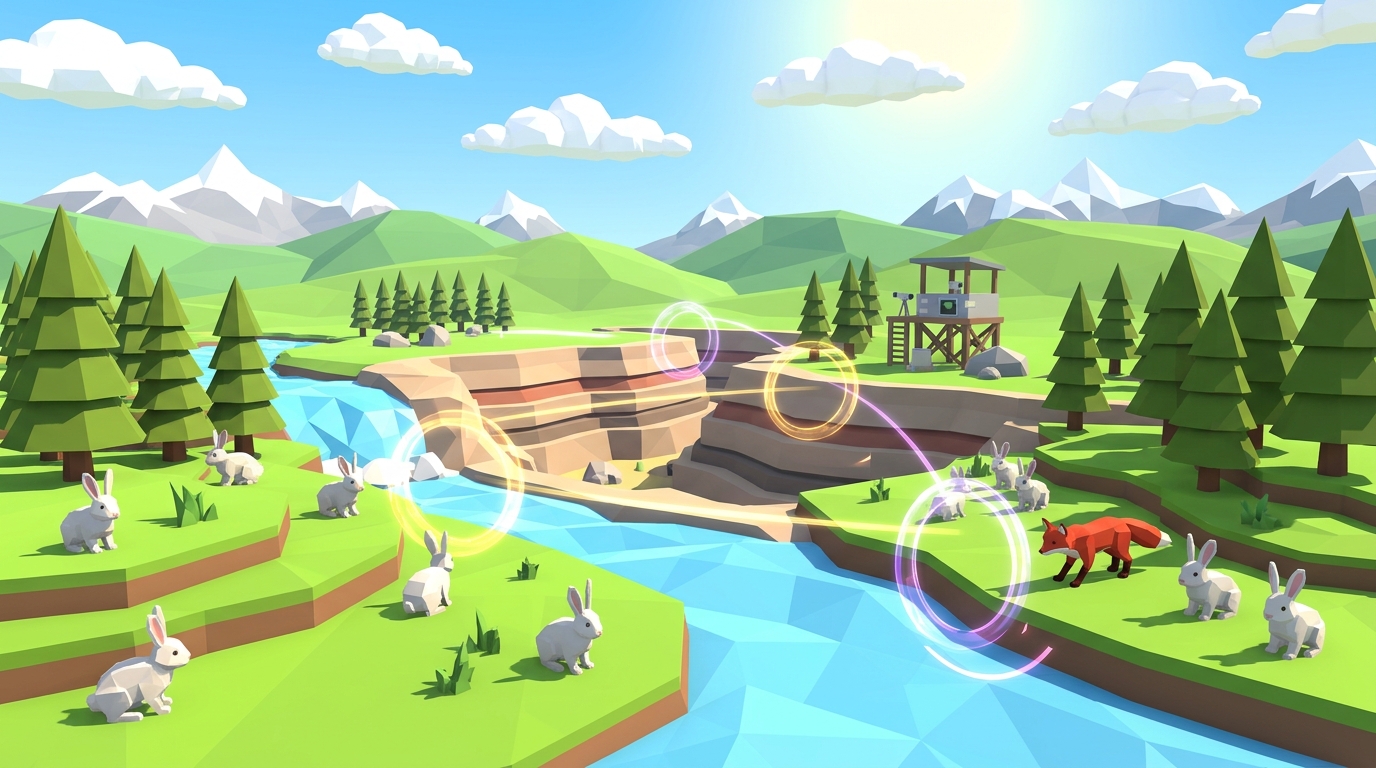
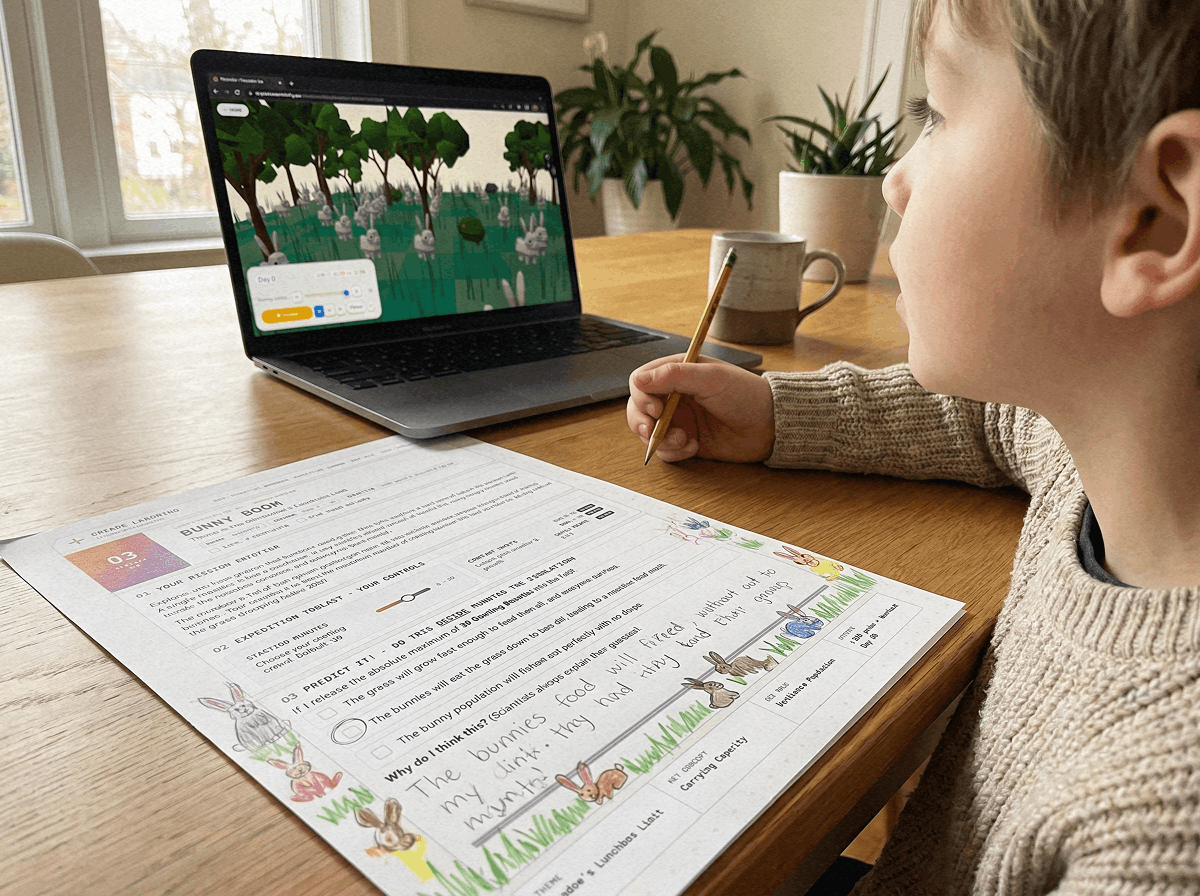
To see how family-style differentiation works in practice, examine how siblings of different ages participate in a single simulation run of Level 3: Bunny Boom (Carrying Capacity):
| Grade Band | Primary Focus Area | Student Journal Task | Core Learning Competency |
|---|---|---|---|
| PRIMARYEarly Elementary (Grades 1-3) | Qualitative Observation & Trophic Roles | Coloring food web cards; tallying animal count highs; identifying that rabbits need grass to live | Connecting living organisms to non-living food requirements |
| ELEMENTARYUpper Elementary (Grades 4-5) | Variable Isolation & Hypothesis Testing | Formulating written predictions; graphing population curves; identifying limiting abiotic factors | Mastering the scientific method and carrying capacity plateaus |
| MIDDLE SCHOOLMiddle School (Grades 6-8) | Quantitative Systems Modeling & Equilibrium | Calculating rate of change; modeling Lotka-Volterra predator lag; designing multi-variable stabilization plans | NGSS MS-LS2 computational thinking and dynamic feedback loops |
The 35-Minute Family Science Morning Routine
You can run a complete, multi-age science block in 35 focused minutes using this open-and-go sequence:
Step 1: Shared Wonder & Central Question (5 Min). Gather at the kitchen table. Introduce the core mission prompt from the 24-page journal: "What happens if we introduce 30 rabbits to an open meadow with no predators?"
Step 2: Differentiated Hypothesis Commitment (5 Min). Before touching any screen, each child writes or sketches their prediction in their own lab notebook according to their grade level.
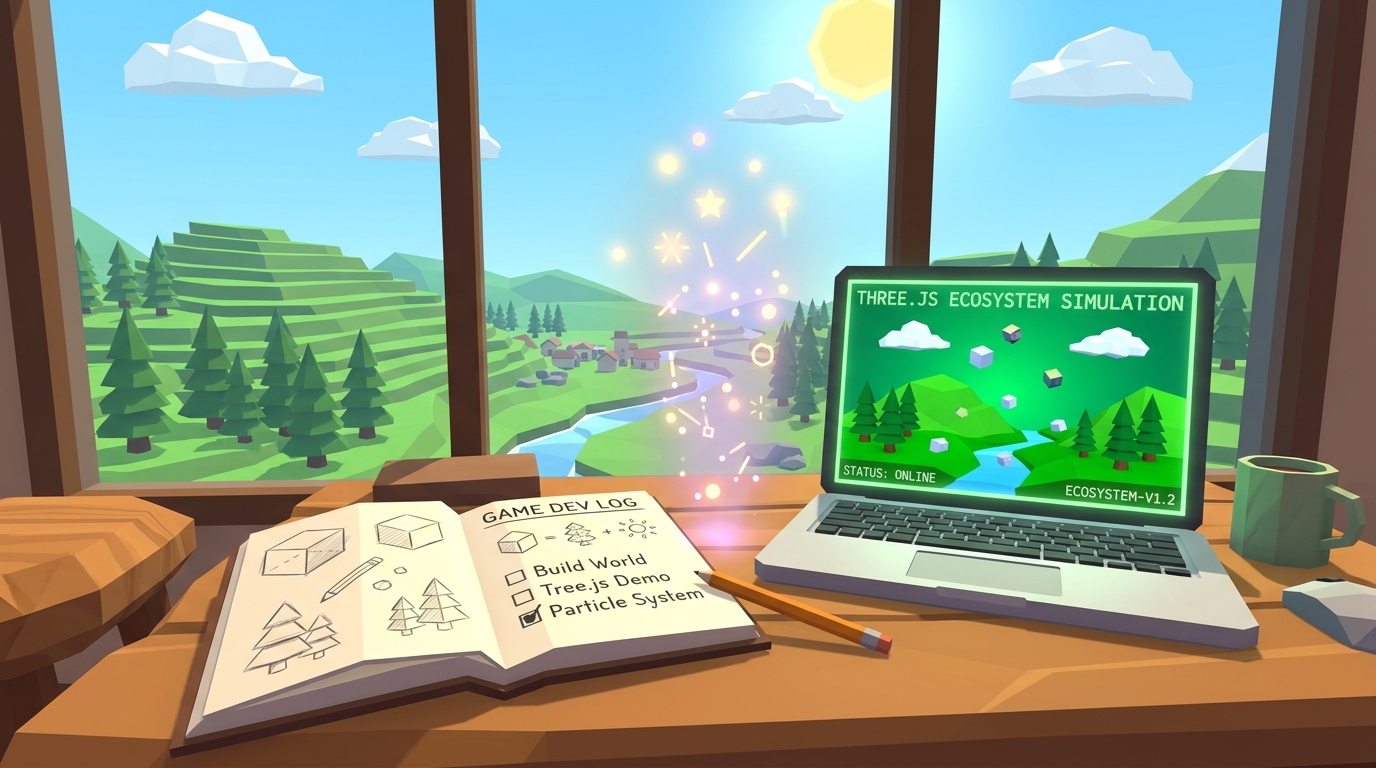
Step 3: Cooperative 3D Digital Trial (15 Min). Open the browser simulation on a laptop, tablet, or cast it to your living room TV. Siblings take turns adjusting sunlight, rain, and animal populations while calling out real-time observations.
Step 4: Individual Data Logging & Outdoor Nature Tie (10 Min). Children complete their respective journal tasks (coloring, graphing, or calculating). Finish with a quick discussion connecting the simulation data to local wildlife in your yard or neighborhood park.
For more strategies on structuring your home science routine, explore my companion guides on printable science worksheets homeschool, best homeschool science curriculum, 30-minute homeschool science routine, and free homeschool science curriculum.
Why 3D Simulations Are the Ultimate Multi-Age Tool
Physical science experiments often fail with multi-age groups: younger siblings spill chemicals, knock over glassware, or distract older kids during delicate measurements.
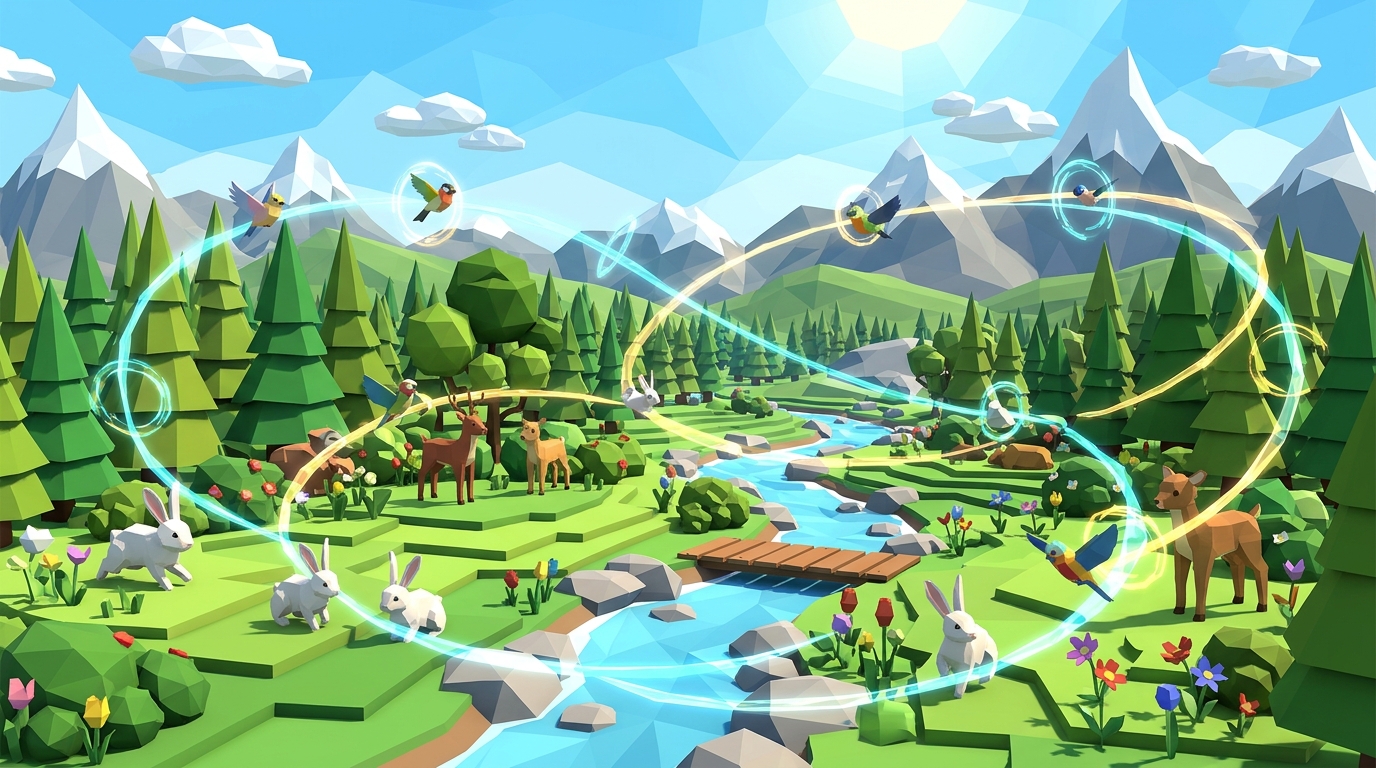
Interactive 3D simulations provide the ideal multi-age environment. The rich visual rendering immediately hooks young children who cannot yet read fluently, while the underlying mathematical deterministic models give older middle schoolers rigorous, authentic data to analyze.
Best of all, when a trial crashes or an animal population goes extinct, resetting the simulation takes exactly one second: allowing the whole family to test ten distinct hypotheses in a single morning.
When siblings explore an interactive 3D habitat together, science shifts from an isolated homework chore into a lively family discovery session.
Frequently Asked Questions About Family-Style Science
Practical advice for homeschooling parents teaching multiple grade levels.
Can you really teach a 3rd grader and an 8th grader using the same curriculum?
How do I grade family-style science for middle school transcripts?
Do I need multiple devices to run family-style simulations?
Are the family-style pacing guide and simulation missions free?
Start Family-Style Science Free in 3D
Gather your family around an interactive living laboratory today.
Start Level 1 instantly in your browser with zero registration. Unlock all 10 simulation missions and download the complete 24-page Expedition Science Journal 100% free with email.
Step inside Level 01: Solar Spark to run your first multi-age family science experiment.
START LEVEL 1 FREEFamily-Style Science Pacing Guide & Journal (PDF)
A complete multi-grade unit planner with differentiated primary, elementary, and middle school experiment sheets and rubric templates.