What Are Abiotic Factors and Why Students Confuse Them With Biotic Factors
In introductory life and earth science courses, one of the most frequent student misconceptions centers around the boundary between living and non-living environmental components. Students often assume that anything found in nature is inherently biotic, mistakenly categorizing rich soil, river currents, or fallen dead leaves as living organisms.
To build genuine ecological intuition, students need a clear, precise foundation: abiotic factors are the non-living physical and chemical elements of an ecosystem. These include solar irradiance, ambient temperature ranges, precipitation levels, atmospheric humidity, soil mineral chemistry, and topographic elevation. Biotic factors, by contrast, are the living organisms: producers, consumers, and decomposers.
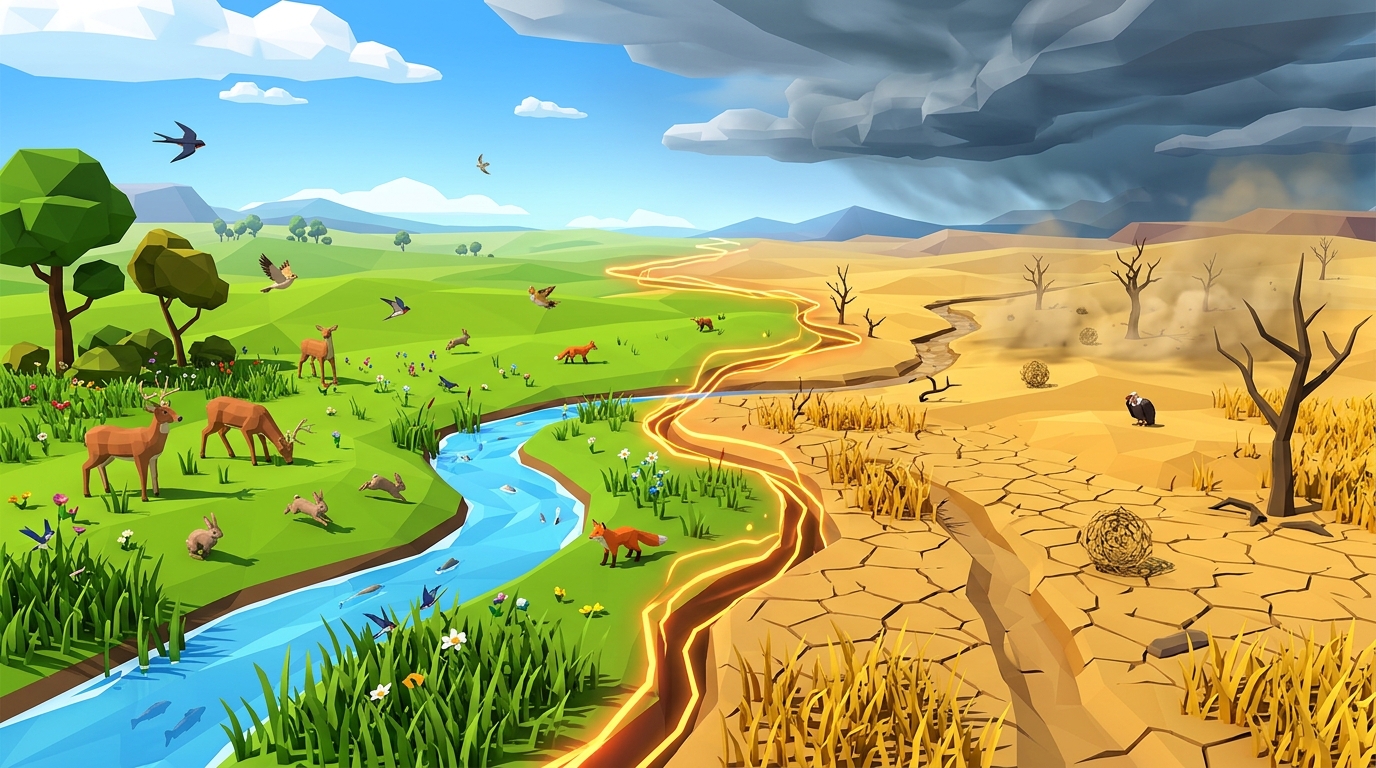
While biological species reproduce and interact through trophic predation, their entire existence is constrained by abiotic boundaries. When a seasonal drought reduces precipitation by 60%, no amount of animal behavior can compensate for the catastrophic loss of primary photosynthetic plant biomass. Modeling these physical constraints in an interactive 3D simulation reveals how deeply physical Earth systems dictate biological survival.
Abiotic variables determine the maximum energetic baseline of an ecosystem. If solar radiance or water levels drop, the carrying capacity of every single trophic level above producers contracts proportionally.
How the Praxos Simulation Engine Models Abiotic Environmental Variables
Rather than treating climate and weather as static textbook background information, the Praxos 3D simulation environment gives students direct physical control over abiotic parameters across progressive mission levels:
1. Level 6 (The Dry Spell): Students simulate an acute multi-season drought by reducing rainfall parameters. Within 40 daily ticks, students observe primary grass biomass wither, triggering secondary herbivore starvation even when apex predators are entirely absent.
2. Level 7 (The Winter Freeze): Students drop ambient temperatures below the plant growth threshold. They observe how biological dormancy, energy conservation, and seasonal seed bank regeneration allow species to survive temporary abiotic extremes.
3. Level 8 & 9 (Interspecific Resource Competition): Students evaluate how abiotic moisture scarcity accelerates competitive exclusion between different herbivore species (rabbits vs. deer) competing for identical depleted vegetation patches.
| Environmental Factor | Classification | Simulation Control | Ecosystem Consequence |
|---|---|---|---|
| PHYSICAL DRIVERSolar Irradiance | Abiotic Factor | Sunlight Intensity Slider (0-100%) | Governs photosynthetic glucose synthesis rate and maximum producer carrying capacity. |
| CLIMATE DRIVERPrecipitation & Moisture | Abiotic Factor | Rainfall Slider & Drought Toggle | Controls soil water saturation, plant hydration levels, and drought die-off speeds. |
| THERMAL GATEAmbient Temperature | Abiotic Factor | Thermal Slider (Freeze / Temperate / Heat) | Sets metabolic speed, seasonal freeze dormancy, and plant growth temperature gates. |
| BIOLOGICAL FORCEHerbivore Grazing Pressure | Biotic Factor | Rabbit & Deer Population Density | Consumes living producer biomass through direct consumer foraging interactions. |
| BIOLOGICAL FORCEApex Predation | Biotic Factor | Wolf Pack Pack Introductions | Regulates herbivore population density through top-down trophic cascades. |
Biotic vs. Abiotic Comparative Classroom Lab (45-Minute Lesson Plan)
This turnkey lesson plan enables educators to guide middle school students through a rigorous empirical comparison between physical abiotic stress (drought) and biological biotic stress (predation):
Pre-Lab Hypothesis in Companion Journal
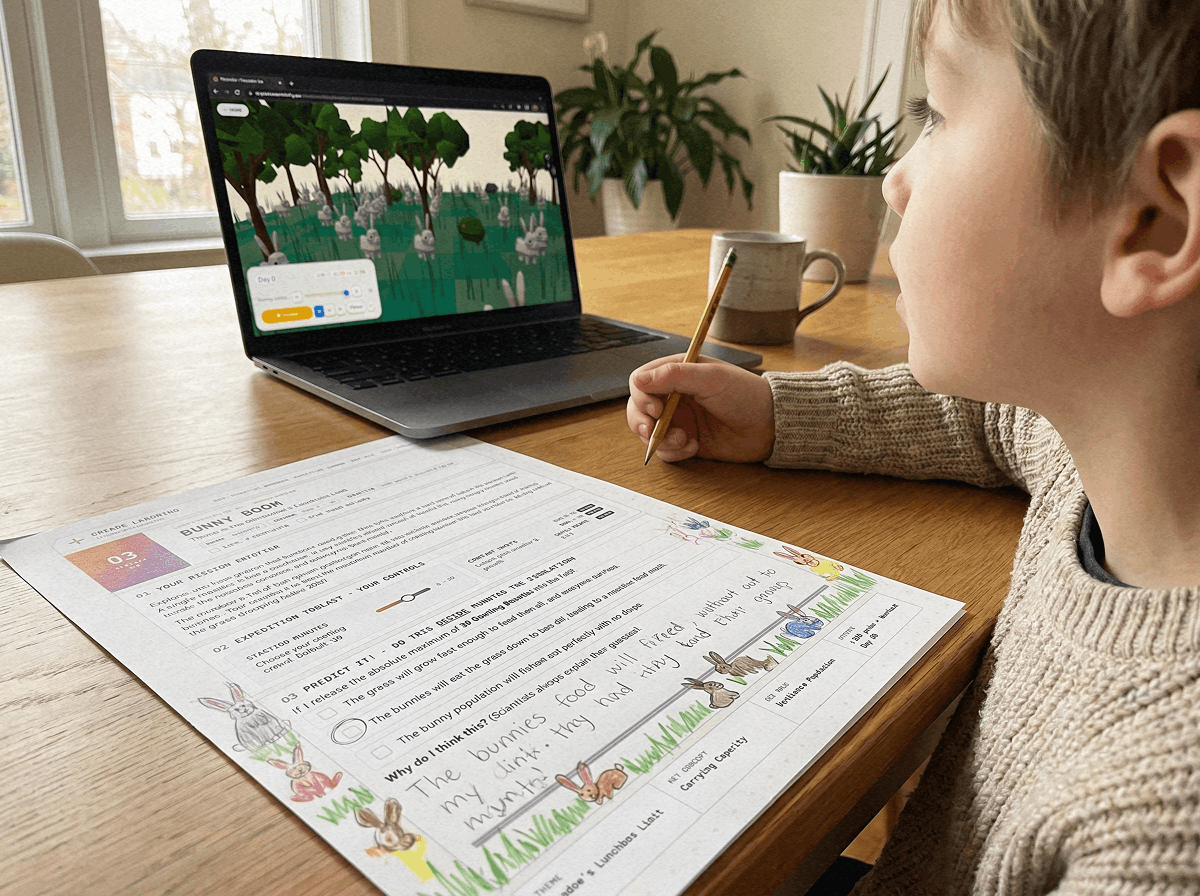
Students open their printed 24-page science logbook and formulate a written prediction: Which variable will trigger a faster herbivore population collapse: a 50% reduction in rainfall (abiotic) or introducing 4 apex wolves (biotic)?
Running the Abiotic Drought Trial (Level 6)
Students launch Level 6 in their browser. They reduce the rainfall parameter to 25% while keeping predator numbers at zero. Students record producer biomass and rabbit counts across 100 simulation ticks.
Running the Biotic Predation Trial (Level 4)
Students reset rainfall to 100% optimal conditions and introduce apex wolves. They record population oscillation curves under purely biotic regulation.
Claim-Evidence-Reasoning (CER) Written Synthesis
Students write a 4-sentence CER scientific argument summarizing their quantitative findings: Abiotic factors set fundamental carrying capacity limits, whereas biotic factors generate dynamic population oscillations.
Real-World Abiotic Events & Environmental Science Connections
Connecting simulation trials to historical ecological events helps students appreciate the high-stakes reality of environmental change:
1. The 2012 North American Great Plains Drought: A severe drop in abiotic precipitation across the central United States devastated corn and grassland biomass, leading to emergency livestock herd reductions and multi-state agricultural economic stress.
2. The 2021 Texas Winter Freeze: Extreme sub-freezing temperatures disrupted non-adapted aquatic and coastal wildlife populations, demonstrating how acute abiotic thermal shocks exceed species tolerance limits.
3. Sahel Desertification & Biome Boundaries: Long-term shifts in atmospheric circulation and rainfall patterns in sub-Saharan Africa show how persistent abiotic drought converts semi-arid grasslands into desert biomes, permanently altering native biodiversity.
Launch Level 1 free in your browser with zero registration. Unlock all 10 simulation missions and the printable 24-page journal completely free with your school email.
LAUNCH FREE 3D LABFrequently Asked Questions from Science Teachers
Practical questions educators ask when incorporating our interactive abiotic simulations into life science and earth systems units.
Is there a free online simulation showing how drought affects food chains?
Can this simulation run on school Chromebooks without IT installations?
Which NGSS standards does this abiotic factors simulation fulfill?
Does this simulation require individual student accounts or emails?
How do abiotic factors cause species extinction in closed ecosystems?
Free Supporting Science & Population Ecology Resources
Enhance your earth systems and ecology units with these free interactive labs and comprehensive teaching guides:
Explore our in-depth curriculum guide on earth science homeschool curriculum covering geology, weather patterns, and abiotic spheres.
Learn how solar energy and soil minerals fuel primary producers in sun, rain, and soil: how plants turn energy into food.
Understand ecological balance with feedback loops explained for kids.
Investigate population carrying capacity with the free carrying capacity simulation game.
Model evolutionary traits and environmental pressure in the free natural selection simulation.
Explore native grassland biome dynamics in the prairie ecosystem simulation.
Equip your students with weather tracking charts, abiotic comparison grids, and CER synthesis worksheets. 100% black-and-white printer friendly.
GET FREE TEACHER PACKAbiotic Factors & Climate Investigation Journal (PDF)
A comprehensive 24-page student inquiry workbook featuring weather data tracking sheets, abiotic vs. biotic comparison matrices, and Claim-Evidence-Reasoning (CER) prompts.