Why Natural Selection Is Hard to Teach Without a Living Demonstration
In traditional life science curricula, natural selection is often introduced through static textbook illustrations: diagrams of peppered moths on soot-covered birch trees or sketches of Darwinian finch beaks. While historically foundational, these static representations frequently leave students with a fundamental misconception: that individual organisms consciously choose to adapt, mutate on demand, or evolve during their own lifetimes.
Natural selection is not an active decision made by an animal; it is an inescapable mathematical outcome produced when environmental constraints collide with population variation. When resources such as food, water, or shelter become scarce, or when apex predators introduce relentless hunting pressure, only individuals with advantageous phenotypic traits survive long enough to pass their alleles to offspring.
Because evolutionary changes in nature unfold across hundreds or thousands of generations, students rarely witness the causal pressure machine that drives adaptation. By compressing ecological lifecycles into real-time interactive 3D simulation ticks, students can directly manipulate carrying capacities, observe resource depletion tipping points, and understand why differential survival is the non-negotiable engine of evolutionary change.
Natural selection requires three prerequisites: phenotypic trait variation, heritable genetic transmission, and selective environmental pressure. Interactive simulation makes the third component directly testable.
How the Praxos Simulation Demonstrates Pre-Selection Ecological Mechanics
Before students can understand modern genetic evolution and allele frequencies, they must first master the ecological conditions that make selection inevitable. The Praxos 3D simulation environment models these core dynamics directly in your web browser:
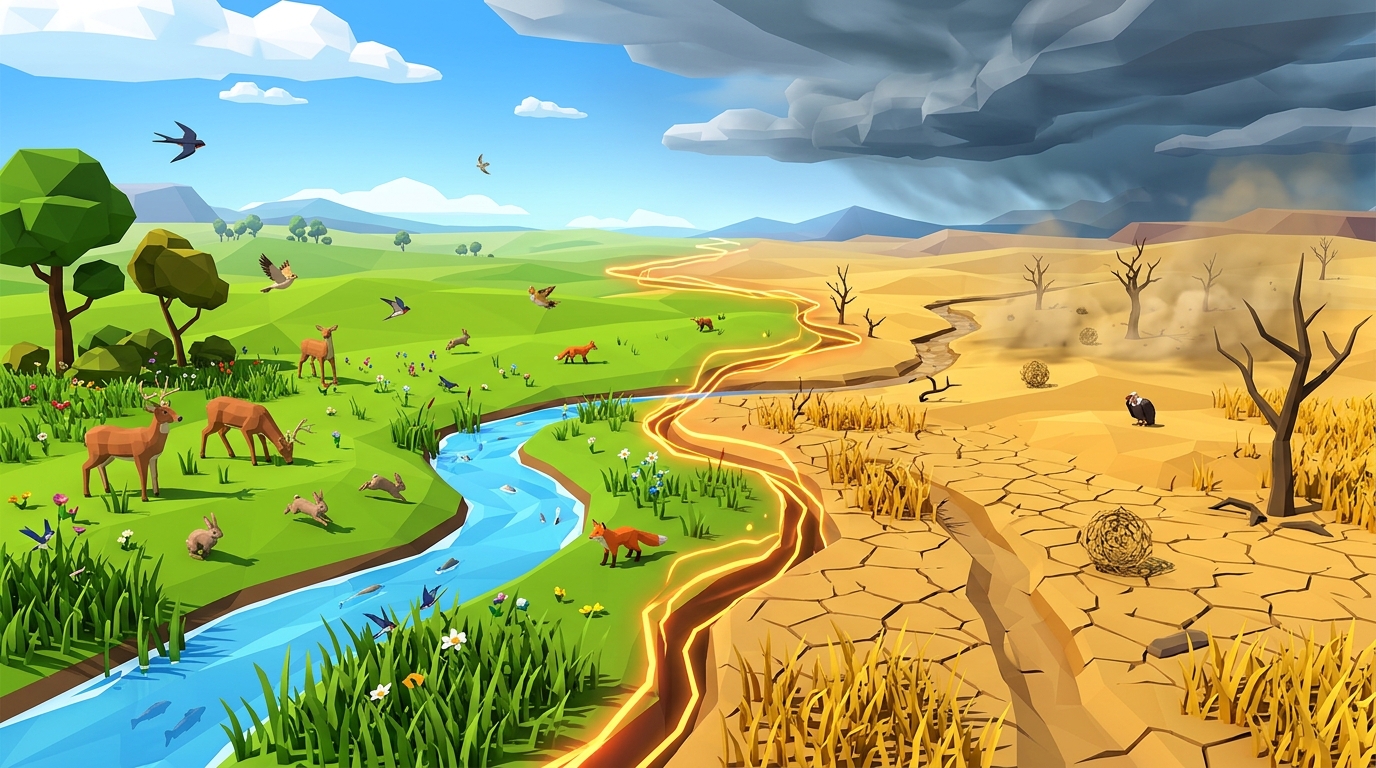
1. Resource Scarcity & Carrying Capacity (Level 3 Bunny Boom): When a herbivore population expands without predator regulation, it overshoots its primary food supply. As grass biomass drops to zero, starvation rates surge exponentially. This proves that survival in nature is never guaranteed; it is strictly constrained by finite energy limits.
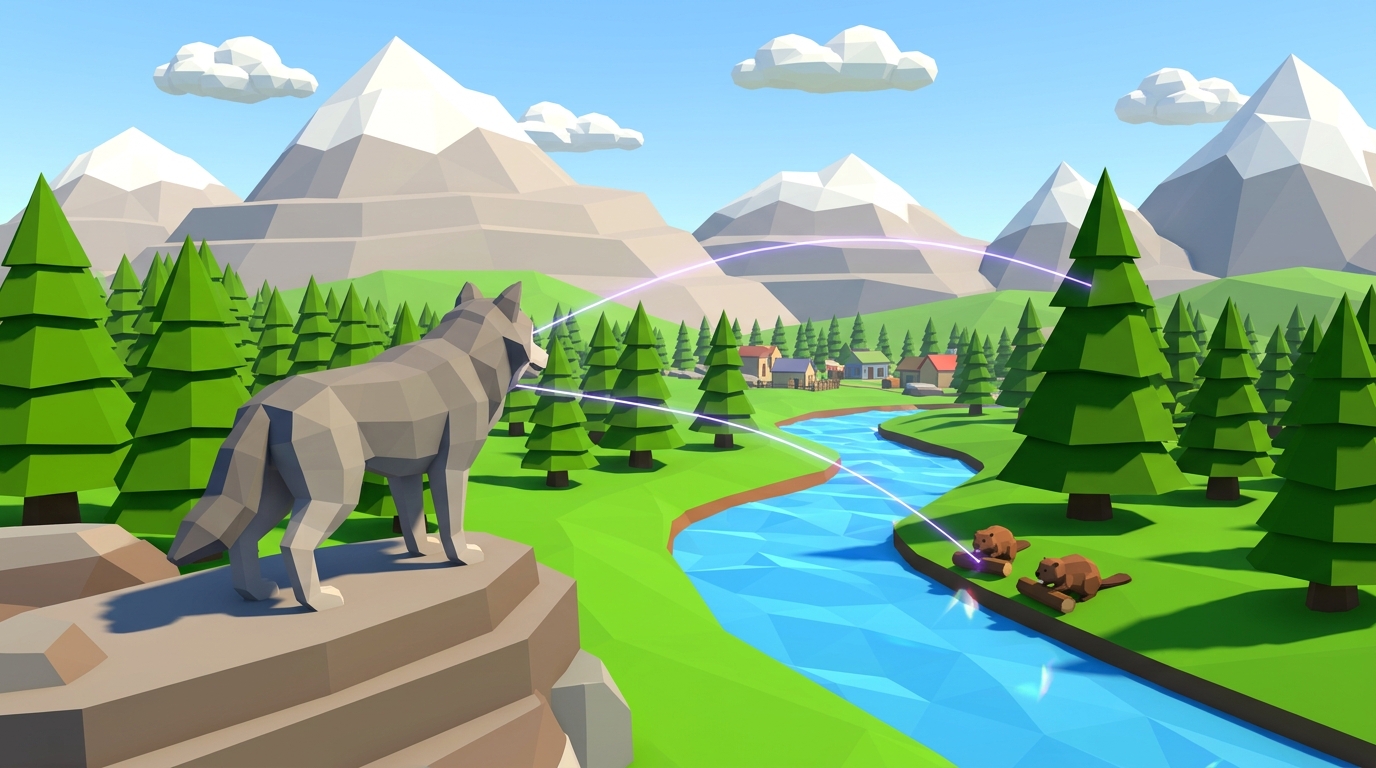
2. Predator Pressure & Spatial Refuge (Level 4 The Gray Shadow): When apex wolves are introduced into the meadow, prey animals with access to high-cover terrain survive at significantly higher rates than those grazing in open clearings. Students observe how environmental geometry creates unequal survival probabilities.
3. Reproductive Rates & Population Viability (Levels 5-10): By adjusting starting densities and observing generational oscillation curves, students discover how reproductive pace balances mortality rates to prevent total species extinction.
| Instructional Dimension | Static Textbook & Worksheet | Physical Card/Dice Game | Praxos 3D Interactive Lab |
|---|---|---|---|
| VISUAL RIGORSelection Pressure Visualization | Static before-and-after diagrams | Abstract dice rolls and counters | Live 3D spatial foraging and real-time mortality ticks |
| INQUIRY DEPTHVariable Control | None (predetermined scenarios) | Manual counting with high error rates | Instant digital parameter sliders (vegetation, predators, water) |
| CLASSROOM EFFICIENCYTime to Observable Data | Passive reading (15-20 min) | Lengthy setup and cleanup (45 min) | Instant zero-setup execution in under 10 seconds |
| NGSS ALIGNEDData Synthesis & Graphing | Memorization of definitions | Disconnected tally marks | Live population curves paired with printable CER lab journals |
The 45-Minute Pre-Natural Selection Bridge Lesson Plan
This structured lesson plan connects ecological population pressure to introductory natural selection standards (NGSS MS-LS4-4 and MS-LS4-2). It is designed to fit cleanly inside a standard 45-minute middle school or junior high class period:
Pre-Lab Hypothesis & Paper Journal Framing
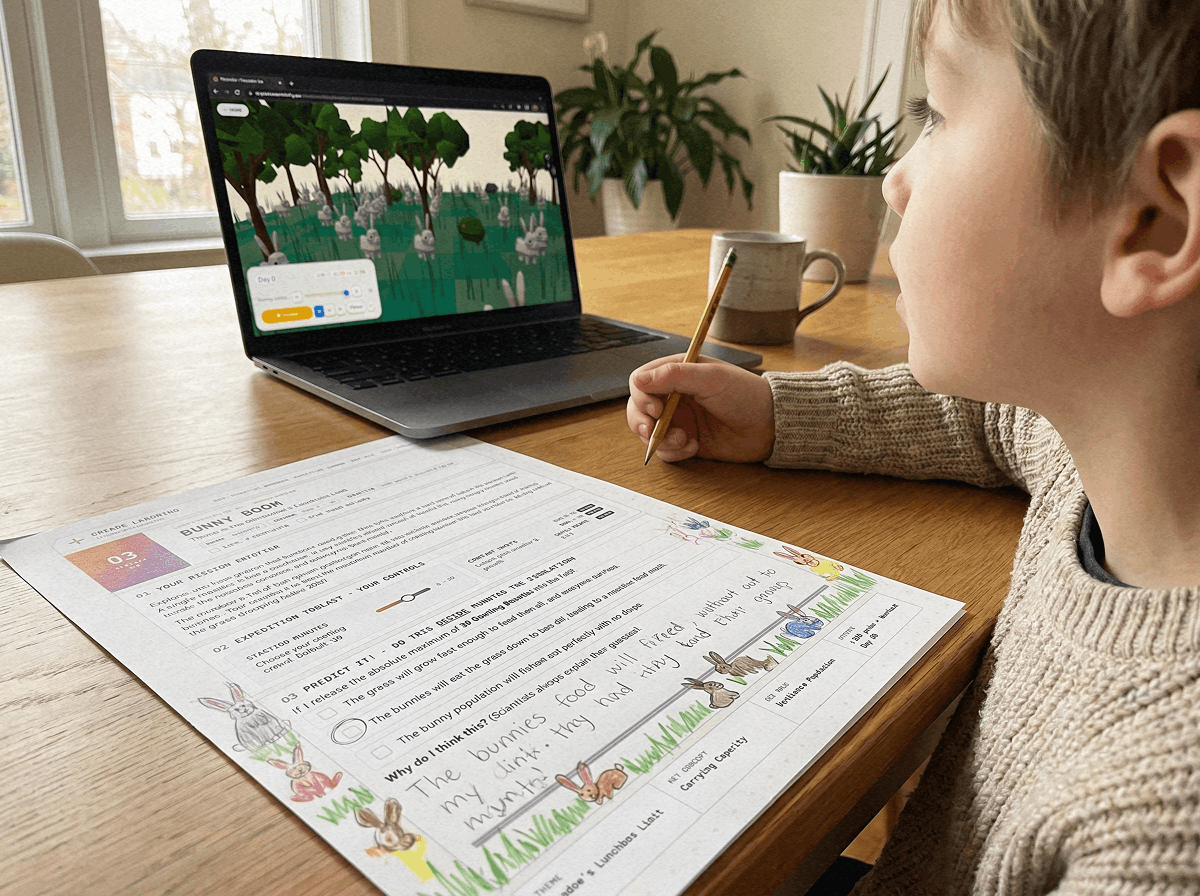
Distribute the printable 24-page lab journal. Ask students to answer the opening inquiry prompt: If 100 rabbits live in a meadow with food for only 50, what determines which individuals survive? Students record their hypotheses on paper.
Running Level 3 (Bunny Boom) Carrying Capacity Trials
Students launch the simulation on their Chromebooks or laptops. In Level 3, they allow the rabbit population to expand until vegetation collapses. Students record the peak population tick, the crash point, and final surviving numbers.
Introducing Apex Predator Pressure in Level 4
Students introduce wolf packs into the system. They observe how predation changes prey distribution and forces herbivores to balance foraging efficiency against predator avoidance.
Claim-Evidence-Reasoning (CER) Written Synthesis
Students complete their 4-sentence CER scientific argument connecting their simulation data to natural selection principles: What traits (speed, camouflage, foraging efficiency) would allow a subset of prey to survive?
NGSS and High School Crossover Standards Alignment
The Praxos simulation platform directly addresses core Next Generation Science Standards across middle school life science and introductory high school biology units:
MS-LS4-4: Construct an explanation based on evidence that describes how genetic variations of traits in a population increase some individuals probability of surviving and reproducing in a specific environment.
MS-LS4-2: Apply concepts of statistics and probability to support explanations that organisms with an advantageous heritable trait tend to increase in proportion to organisms lacking this trait.
HS-LS4-2: Construct an explanation based on evidence that the process of evolution primarily results from four factors: the potential for a species to increase in number, heritable genetic variation, competition for limited resources, and the proliferation of better-adapted organisms.
MS-LS2-1: Analyze and interpret data to provide evidence for the effects of resource availability on organisms and populations in an ecosystem.
Level 1 launches immediately in your web browser with zero login or setup. Unlock all 10 simulation missions and the printable 24-page science journal 100% free.
LAUNCH FREE 3D LABFrequently Asked Questions from Science Teachers
Common questions educators ask when using our interactive simulation tools to teach environmental pressure and natural selection units.
Can students run this simulation on school Chromebook carts without downloading anything?
At what grade levels is this natural selection simulation most effective?
Does this simulation require student email accounts or personal data?
How does ecological resource pressure connect to genetic mutation and allele frequency?
Is the simulation free for entire classrooms and homeschool co-ops?
Free Supporting Science & Population Ecology Resources
Expand your evolutionary biology and ecosystem units with these free interactive labs and comprehensive teaching guides:
Explore our in-depth informational guide on natural selection simulation for kids to examine phenotypic variation and environmental filters.
Investigate apex predator top-down regulation with the trophic cascade simulation online.
Model herbivore population explosions and carrying capacity limits with the free carrying capacity simulation game.
Examine Lotka-Volterra mathematical wave curves in our free predator-prey simulation.
Explore native grassland biome energy flows in the prairie ecosystem simulation.
Equip your students with structured CER hypothesis grids, coordinate population graphing sheets, and vocabulary rubrics. 100% black-and-white printer friendly.
GET FREE TEACHER PACKNatural Selection & Ecosystem Dynamics Lab Journal (PDF)
A comprehensive 24-page inquiry workbook with hypothesis prompts, population data tables, and Claim-Evidence-Reasoning (CER) synthesis worksheets.