The Prairie Biome: North America's Dynamic Living Grassland
The North American prairie is one of the most widely studied biomes in elementary and middle school science education. Spanning from the Great Plains across the Midwest, temperate grasslands represent a landscape shaped by sunlight, seasonal precipitation, periodic drought, and tightly interconnected food chains.
Despite its ecological importance, teaching the prairie ecosystem through static textbook diagrams often falls flat. On a worksheet, students see a drawing of prairie grass connected by arrows to a cottontail rabbit, a white-tailed deer, and a red fox. But they cannot see the living rhythm of the grassland: how fast prairie plants bounce back after rain, what happens when unchecked grazing turns lush sod into dry dust, or how apex predators protect plant biodiversity.
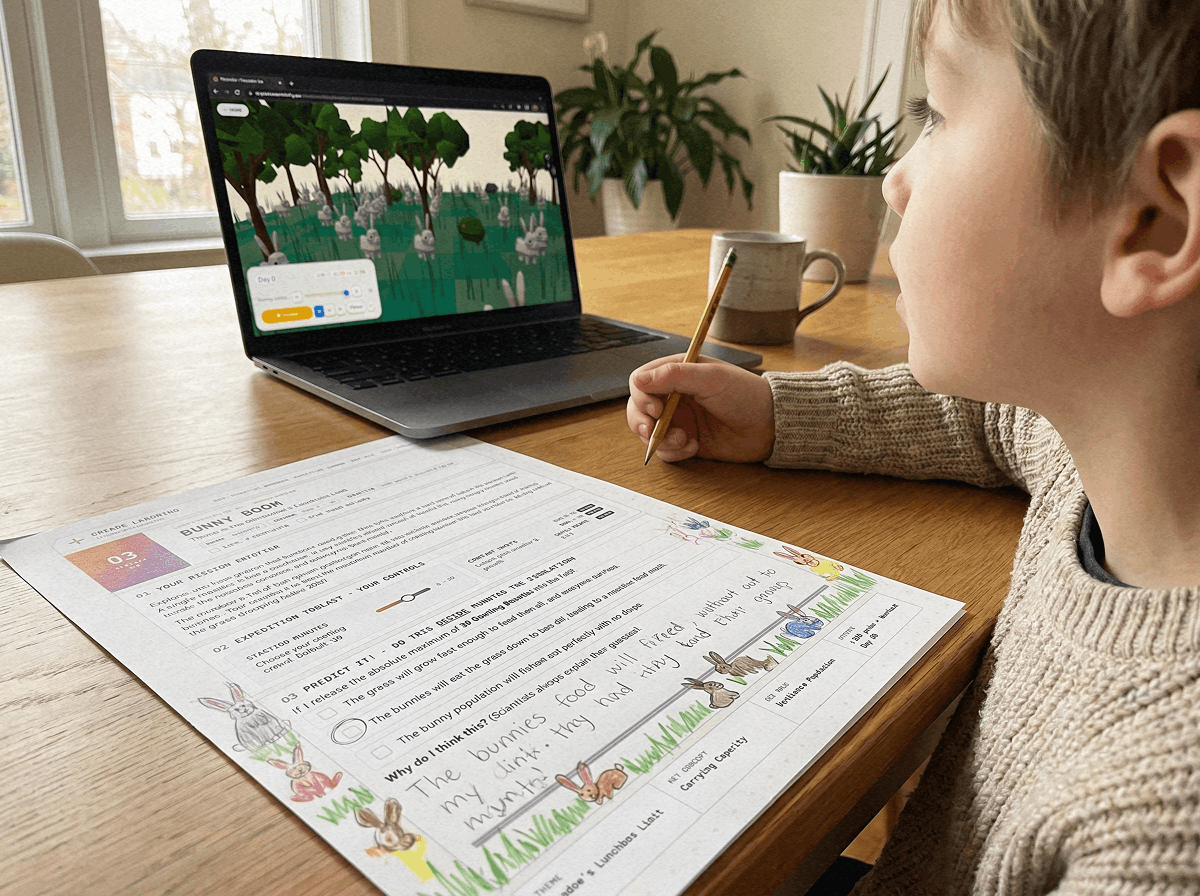
I built the Praxos 3D simulation to bring the prairie biome to life. Kids ages 7 to 12 can step directly into a 3D grassland environment, adjust environmental levers, introduce native prairie species, and observe real ecological balancing acts in real time.
Start Level 1 instantly in your browser. Cultivate native grasses, balance grazer populations, and watch grassland dynamics unfold. All 10 levels are 100% free with email.
LAUNCH 3D PRAIRIE LABNative Prairie Food Web Species in the Praxos 3D Simulation
The Praxos simulation models the core trophic levels of a North American temperate grassland with scientific accuracy and intuitive 3D visuals:
Producers (Prairie Grasses & Wildflowers): Deep-rooted C4 grasses convert solar energy and moisture into foundational biomass. In the simulation, grass regrowth rates respond dynamically to sunlight intensity and soil moisture.
Primary Consumers (Cottontail Rabbits): Rapidly reproducing small herbivores that depend on dense ground-level vegetation. In Level 2 and Level 3 (Bunny Boom), kids see how quickly rabbit colonies can multiply when food is abundant.
Primary Consumers (White-Tailed Deer): Larger grazing herbivores that consume substantial biomass per individual. Managing both rabbits and deer requires kids to balance multiple grazing pressures simultaneously.
Secondary & Apex Predators (Red Foxes & Gray Wolves): Natural regulators of the grassland. In Level 4 (The Gray Shadow), introducing predators demonstrates top-down population regulation: predators keep herbivore numbers in check, allowing overgrazed prairie grasses to regenerate.
Tertiary Raptor (Prairie Hawk): Soaring raptors provide aerial predation over small mammal populations, completing a realistic three-dimensional grassland food web.
Prairie Biome Learning Methods & Tools Compared
Here is how different teaching approaches compare for exploring grassland ecology and prairie food chains with kids ages 7 to 12:
| Learning Method | Hands-On Depth | Ecological Realism | Data Quality | Cost |
|---|---|---|---|---|
| Textbook prairie biome chapter | Low (passive reading) | Low (static illustrations) | None (predetermined facts) | Textbook cost |
| Diorama or poster project | Moderate (arts and crafts) | Low (decorative representation) | None (art focus) | Materials cost |
| 2D Flash food chain games | Moderate (drag-and-drop) | Basic (linear animations) | Low (score-based) | Free |
| 100% FREEPraxos 3D Prairie Simulation | Very High (full sandbox controls) | High (real-time population feedback) | Quantitative (live tick graphs) | Free (all levels + journal) |
45-Minute Prairie Grassland Classroom & Homeschool Lab
This guided science lab fits cleanly into a 45-minute lesson plan for classroom teachers or a dedicated home science block for homeschool families:
Phase 1: Pre-Lab Grassland Hypothesis (10 minutes). Distribute the printed 24-page Expedition Science Journal. Kids turn to the Prairie Ecosystem Investigation page and record their initial prediction: "If rainfall is high but no predators are present in the prairie, I predict the rabbit population will _____ because _____."
Phase 2: Three-Scenario Simulation Trials (20 minutes). Students run three experimental scenarios: Trial 1 (Grassland Foundation: setting optimal sun and rain to measure peak grass biomass). Trial 2 (Unchecked Grazers: adding rabbits and deer with zero predators to record overgrazing threshold). Trial 3 (Balanced Prairie Web: introducing foxes and wolves to measure how predator presence stabilizes grass biomass). Kids log population tick counts every 10 ticks.
Phase 3: CER Written Synthesis & Reflection (15 minutes). Students write a Claim-Evidence-Reasoning response. Claim: How do predators help keep prairie grasslands green? Evidence: Specific grass density and population data from Trial 2 vs. Trial 3. Reasoning: Explain the trophic cascade that connects wolves, deer, and prairie vegetation.
Multi-Grade Science Standards & Adaptations (Grades 3-7 / Ages 7-12)
The prairie simulation adapts across multiple age groups and curriculum standards:
Grades 3 to 5 (Ages 7-10 / NGSS 5-LS2-1): Focus on energy transfer from sunlight to prairie grass to herbivores. Kids draw prairie food chains in their journal and observe what happens when herbivores run out of food.
Grades 6 to 7 (Ages 11-12 / NGSS MS-LS2-1 & MS-LS2-2): Focus on variable isolation, resource limits, and ecological interactions. Students graph population oscillations, test drought tolerance in Level 7, and write formal CER lab reports.
Level 1 runs instantly in any web browser with zero registration. All 10 simulation missions and the complete 24-page printable CER journal are 100% free with your email.
Classroom Hardware & Chromebook Frictionless Setup Guide
The Praxos simulation is engineered to eliminate common technical barriers in school and home settings:
Tested Browsers: Full compatibility with Google Chrome 90+, Microsoft Edge 89+, Apple Safari 14+, and Mozilla Firefox 85+.
Hardware Support: Runs at a steady 60 frames per second on standard school Chromebooks (2GB RAM), iPads, and laptops.
Zero IT Friction: No software downloads, browser plugins, or admin passwords required. Students open the URL and begin experimenting immediately.
Student Privacy: Zero student personal identifiable information (PII) is collected, complying with classroom privacy standards.
Frequently Asked Questions From Parents & Science Teachers
Answers to common questions about using the Prairie Ecosystem Simulator for science education.
Why is the prairie ecosystem such an effective model for teaching food webs?
Can my children or students use this on iPads or Chromebooks?
Is this simulation free for multiple students at once?
How does the prairie simulation connect to seasonal weather and drought?
Does this resource include printable worksheets?
Free Supporting Prairie & Ecology Resources
Deepen your grassland study with these complementary free guides:
The prairie food chain guide provides an in-depth reading overview of North American grassland organisms and energy flow.
The food web vs food chain guide breaks down the differences between simple chains and complex ecological webs.
The free food web simulator for kids lets kids build multi-tiered food webs across 10 progressive missions.
The carrying capacity simulation game lets kids explore population limits and resource balance in Level 3.
Get the complete printable prairie and ecology lab journal with grassland food chain diagrams, data tables, and CER reflection prompts. Formatted for easy black-and-white printing.
GET FREE LAB JOURNAL24-Page Expedition Science Journal
A printable CER lab journal with grassland food chain mapping pages, population tick grids, and reflection prompts designed for kids ages 7-12.