The Middle School Transition: Why Junior High Science Requires Computational Thinking
In elementary school, science is primarily observational: identifying tree leaves, classifying animal tracks, and reading nature stories. By the time students enter junior high (grades 6, 7, and 8), their cognitive development requires a fundamental shift toward quantitative reasoning, variable control, and systems modeling.
Standard junior high curricula often struggle with this transition. Some programs remain overly simplistic, relying on repetitive vocabulary flashcards. Others jump directly to dense, dry high school textbooks that drain student enthusiasm and create math anxiety.
An effective junior high science program bridges this gap by combining authentic inquiry with computational tools: allowing middle schoolers to test complex hypotheses, graph population curves, and analyze dynamic feedback loops inside interactive 3D browser sandboxes.
Junior high science serves as the vital bridge between elementary wonder and high school rigor. It transitions students from qualitative nature observation to quantitative hypothesis testing, data graphing, and multi-variable systems modeling.
Comprehensive Scope & Sequence: Grades 6, 7, and 8 Breakdown
Whether you follow a discipline-specific pathway (Biology in 6th, Earth Science in 7th, Physical Science in 8th) or an integrated general science model, here is the standard junior high scope and sequence aligned to NGSS standards:
| Grade Level | Primary Discipline | Core Scientific Concepts | Hands-On Lab & Simulation Component |
|---|---|---|---|
| LIFE SCIENCE6th Grade Science | Life Science & Ecosystem Dynamics | Cellular biology, photosynthesis energy transfer, food webs, carrying capacity limits, trophic cascades | Praxos 10-Mission 3D Ecosystem Simulation & 24-Page Expedition Journal |
| EARTH SCIENCE7th Grade Science | Earth & Space Systems | Plate tectonics, rock cycle, abiotic climate drivers, ocean currents, atmospheric weather patterns | Topographic biome mapping, rock sample density labs, and weather station logging |
| PHYSICAL SCIENCE8th Grade Science | Physical Science & Energy | Atomic structure, chemical reactions, Newton's laws of motion, kinetic vs potential energy, wave physics | Pendulum velocity tracking, marble roller coaster physics, and density column experiments |
How to Structure a 3-Day Weekly Junior High Science Rhythm
Junior high students thrive when science follows a consistent, predictable weekly rhythm that balances independent reading with hands-on experimentation:
Day 1: Concept Exploration & Scientific Context (40 Min). Introduce the weekly core topic through engaging narrative reading, public library reference spines, or primary source scientific articles. Have the student summarize the primary mechanism in their lab notebook.
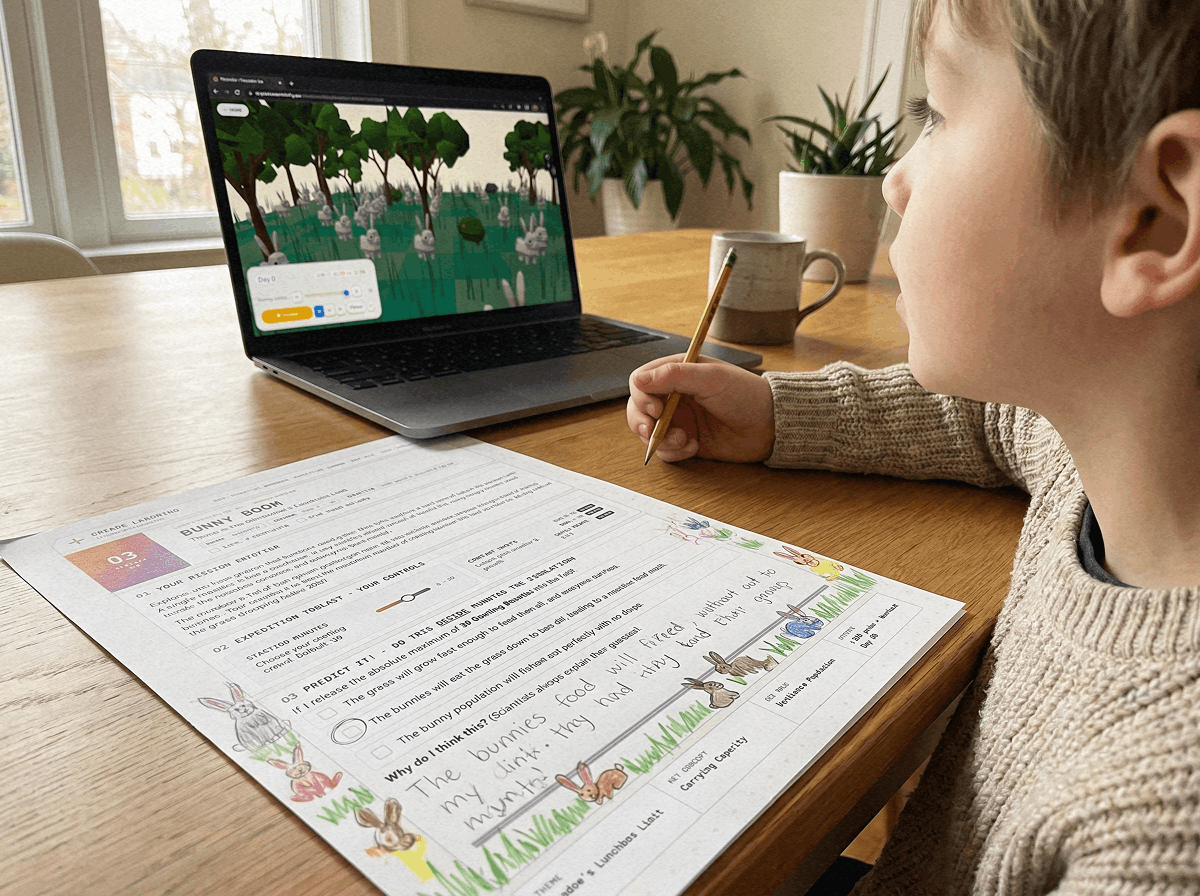
Day 2: Interactive 3D Lab Simulation & Hypothesis Testing (45 Min). Students open the browser simulation to isolate variables and test extreme conditions (such as doubling predator density or cutting sunlight by 50%). They record real-time numerical data in their journal.
Day 3: Quantitative Graphing & Lab Report Synthesis (40 Min). Students plot their trial data onto coordinate grids, calculate percentage changes, reflect on unexpected results, and write a concise four-sentence conclusion.
For more curriculum planning strategies, explore my companion guides on middle school science topics homeschool, 5th grade science curriculum, earth science homeschool curriculum, and affordable homeschool curriculum.
Transitioning to High School: 4 Skills Junior High Students Must Master
1. Isolating Independent vs Dependent Variables: Middle schoolers must master the "One Slider Rule": never changing multiple variables simultaneously during a controlled experiment.
2. Quantitative Coordinate Graphing: Students should comfortably plot linear and oscillating curves by hand, recognizing plateaus, peak carrying capacities, and predator-prey lag cycles.
3. Error Analysis and Reframing Failure: Rather than faking data when an experiment fails, junior high scientists must objectively analyze why the system crashed and document what it taught them.
4. Systems Thinking and Second-Order Effects: Understanding that changing one variable in a complex habitat triggers cascading feedback loops across multiple trophic levels.
Frequently Asked Questions About Junior High Science
Common questions from middle school homeschool parents and STEM mentors.
Should junior high science be taught as integrated science or separate subjects?
How do I handle middle school science labs without a home laboratory?
How many hours per week should a junior high student spend on science?
Is the Praxos junior high ecology curriculum completely free?
Start Junior High Science Free in 3D
Equip your middle schooler with the quantitative modeling tools they need for high school success.
Start Level 1 instantly in your browser with zero registration. Unlock all 10 simulation missions and download the complete 24-page Expedition Science Journal 100% free with email.
Step inside Level 01: Solar Spark to model your first junior high ecosystem investigation.
START LEVEL 1 FREEJunior High Ecology Unit & Pacing Guide (PDF)
A complete 10-mission middle school science logbook with coordinate graphing grids, hypothesis testing templates, and rubric sheets.