Beyond Test Scores: Why Homeschool Evaluators Value Portfolios Over Worksheets
When state homeschool evaluators, certified teachers, or umbrella school reviewers inspect your child's academic records, a stack of multiple-choice worksheets rarely impresses them. Anyone can circle letter B on a vocabulary quiz without understanding the underlying science.
What evaluators truly look for is proof of authentic scientific inquiry: evidence that the student can formulate a testable hypothesis, record quantitative data, plot coordinate graphs by hand, and explain why an experiment succeeded or failed.
A curated science portfolio transforms your homeschool science block from an invisible daily routine into an impressive, permanent artifact of academic growth. It demonstrates mastery of NGSS crosscutting concepts and provides lifelong documentation of your child's intellectual curiosity.
A science portfolio provides undeniable proof of academic progress. By compiling handwritten hypothesis notes, population graphs, and error reflections into a structured binder, parents demonstrate rigorous NGSS alignment during annual state reviews.
The 5 Essential Components of an Evaluator-Ready Science Portfolio
To build a clean, professional science portfolio that satisfies state compliance and delights evaluators, organize your student's binder around these five core sections:
1. Portfolio Title Page & Student Info Sheet. Include the student's full name, academic school year, grade level, and a concise course summary (e.g., "Grades 4-6 Life Science & Ecosystem Dynamics: NGSS MS-LS2 Aligned").
2. Scope, Sequence & Pacing Index. A one-page table listing all 10 completed missions, the primary scientific concept taught (e.g., Photosynthesis, Trophic Cascades, Carrying Capacity), and the completion date.
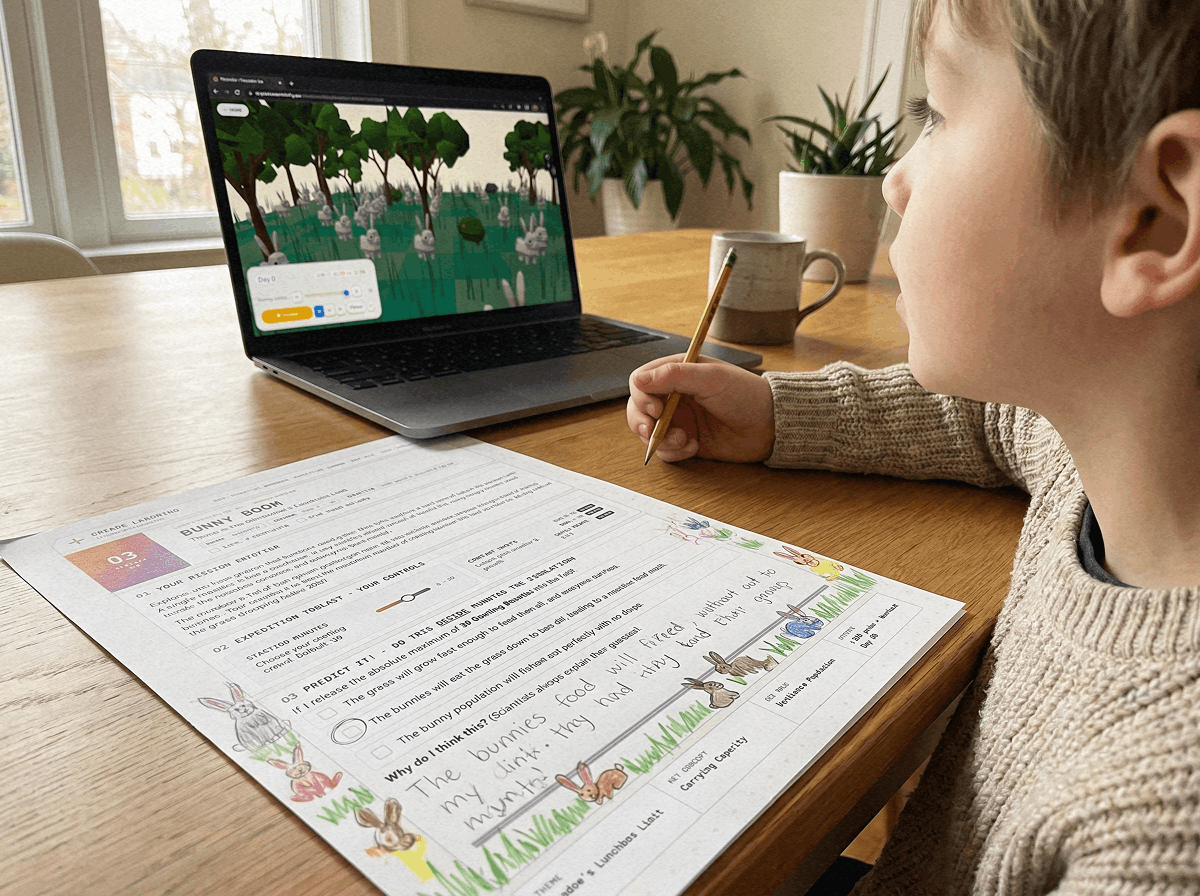
3. Core Experiment Lab Spreadsheets (The Meat of the Binder). The completed mission pages from the 24-page Expedition Journal. Each sheet must show the student's handwritten prediction, isolated control variables, and recorded observations.
4. Quantitative Graphs & Data Coordinate Grids. Hand-drawn graphs plotting population curves, abiotic variable sliders, and carrying capacity plateaus. Evaluators love seeing hand-plotted math integrated into science.
5. Error Reflections & Certificate of Scientific Mastery. The completed "My Best Mistake" debrief sheet alongside the signed Certificate of Mastery awarded upon completing all 10 simulation levels.
Curriculum Comparison: 6 Homeschool Science Formats Evaluated for Portfolio Proof
Different homeschool science programs produce vastly different types of portfolio evidence. Here is how the six most common approaches compare:
| Science Curriculum Format | Physical Portfolio Artifacts | Inquiry Depth Evidence | Math & Graphing Integration | Evaluator Impression |
|---|---|---|---|---|
| TRADITIONALTraditional Boxed Textbooks | Filled-in chapter worksheets & quiz bubble sheets | Low (rote memorization of definitions) | Low (minimal original data collection) | Adequate (shows completion, but lacks inquiry spark) |
| LIVING BOOKSCharlotte Mason Living Books | Nature journal watercolor sketches & written narrations | Moderate (great descriptive observation) | Low (rarely includes quantitative math) | Good (captivates with artistic and narrative beauty) |
| SUBSCRIPTIONMonthly Subscription Kits | Plastic craft models & brief assembly check-sheets | Low (one-time craft build over hypothesis testing) | None (rarely involves continuous data logging) | Weak (looks like disposable toys rather than coursework) |
| VIDEO ONLYOnline Video Lecture Portals | Automated computer quiz scores & completion bars | Low (passive screen watching) | Low (multiple choice calculations) | Moderate (requires printing computer transcripts) |
| UNIT STUDYThematic Unit Study Binders | Themed lapbooks, vocabulary foldables, and essays | Moderate to High (great interdisciplinary integration) | Moderate (depends on chosen unit focus) | Very Good (comprehensive thematic presentation) |
| BEST PORTFOLIOHybrid 3D Simulation + Journal (Praxos) | 10 handwritten lab logs, coordinate graphs, and mastery certificate | High (iterative variable testing & systems modeling) | High (hand-drawn Lotka-Volterra & carrying capacity curves) | Outstanding (clear NGSS alignment with rigorous lab data) |
The 4-Quarter Science Portfolio Rhythm: A Year-Long Framework
Building an impressive portfolio does not require a frantic scramble at the end of the school year. Follow this steady four-quarter pacing schedule:
Quarter 1: Foundations of Energy & Primary Producers (Missions 1-3). Focus on photosynthesis, solar photons, plant biomass, and basic food chain arrows. Include photos of local plant life paired with simulation data sheets.
Quarter 2: Consumer Trophics & Carrying Capacity (Missions 4-6). Model herbivore surges, resource limits, and carrying capacity plateaus. Graph exponential growth and subsequent population crashes.
Quarter 3: Apex Predators & Dynamic Equilibrium (Missions 7-8). Investigate trophic cascades (the Yellowstone wolf model) and Lotka-Volterra oscillating equilibrium in Level 5.
Quarter 4: Capstone Investigation & Mastery Presentation (Missions 9-10). The student designs an independent sandbox trial, presents their findings to the family, and binds the completed journal with the Certificate of Mastery.
For more advice on structuring your homeschool STEM documentation, explore my companion guides on printable science worksheets homeschool, best homeschool science curriculum, how to teach the scientific method to kids, and junior high science curriculum.
Frequently Asked Questions About Homeschool Science Portfolios
Practical questions from homeschool parents preparing for annual evaluations.
How many lab samples should I include in a homeschool science portfolio?
Can digital simulation data count as authentic lab work for state evaluations?
Do I need to assign letter grades for portfolio science?
Are the portfolio cover pages and 24-page Expedition Journal free?
Start Building Your Science Portfolio Free in 3D
Transform your homeschool science into an evaluator-ready showcase of authentic discovery.
Start Level 1 instantly in your browser with zero registration. Unlock all 10 simulation missions and download the complete 24-page Expedition Science Journal 100% free with email.
Step inside Level 01: Solar Spark to record your first portfolio experiment data in real time.
START LEVEL 1 FREEScience Portfolio Starter Kit & 24-Page Journal (PDF)
Includes printable binder cover sheets, table of contents templates, 10 mission experiment spreads, and the official Certificate of Mastery.