The Shaken Soda Bottle Paradox: Why Water Sparks Earth's Most Violent Blasts
If you pour water onto a blazing campfire, the liquid absorbs heat and extinguishes the flame. Common sense suggests that water is nature's greatest fire suppressant. Yet inside a volcanic conduit, water plays the exact opposite role: it is the single most destructive explosive agent on planet Earth.
To understand how water powers volcanic cataclysms, consider what happens when you vigorously shake a warm plastic bottle of carbonated soda. While the cap remains tightly sealed, the liquid inside appears completely calm and clear. Dissolved carbon dioxide gas is forced into physical solution under high pressure, obeying Henry's Law.
The moment you twist the cap and break the seal, the pressure drops instantly from several atmospheres to normal air pressure. The dissolved gas rapidly exsolves, nucleating billions of expanding carbon dioxide bubbles that violently froth and spray soda out of the nozzle at high speed.
Underground magma chambers behave like planetary soda bottles. At depths of 5 to 10 kilometers beneath a subduction zone, staggering lithostatic pressure forces up to 4% to 6% dissolved volatile gases (predominantly supercritical water vapor, accompanied by carbon dioxide and sulfur dioxide) directly into molten andesite and dacite magma. When tectonic fractures crack open the volcanic conduit, sudden decompression triggers instantaneous, runaway gas expansion, turning liquid stone into a supersonic volcanic cannon.
Volcanic eruptions are powered by depressurization: when subterranean pressure drops, dissolved water flashes into expanding steam, expanding over 1,000 times in volume and shattering viscous magma into supersonic clouds of volcanic ash.
The Anatomy of a Plinian Eruption Column: Gas Thrust, Convection, and Umbrella Spreading
The towering vertical ash clouds associated with explosive volcanism are called plinian eruption columns, named after the Roman magistrate Pliny the Younger, who documented the catastrophic eruption of Mount Vesuvius in 79 AD from across the Bay of Naples.
A plinian column is not a simple cloud of smoke; it is a complex, three-stage thermodynamic engine that rises through Earth's atmosphere:
1. The Gas Thrust Region (Jet Nozzle): In the lowest 1 to 3 kilometers directly above the volcanic crater, decompression accelerates gas and magma fragments out of the vent at velocities between 100 and 600 meters per second (faster than the speed of sound). In this supersonic zone, the column is significantly denser than the surrounding cold atmosphere, propelled upward purely by explosive kinetic energy.
2. The Convective Buoyancy Region (The Thermal Chimney): As the high-speed jet surges upward, turbulent friction entrains enormous volumes of ambient atmospheric air into the plume. The incandescent ash fragments (at temperatures exceeding 800°C) flash-heat the entrained air. The heated air expands, dramatically lowering the bulk density of the mixture until it becomes lighter than the ambient atmosphere. The column becomes buoyant, rising smoothly through the troposphere like a colossal hot air balloon.
3. The Stratospheric Umbrella Region: The buoyant chimney continues to climb until it crosses the tropopause into the stratosphere, reaching an altitude of 15 to 35 kilometers. Eventually, the expanding plume reaches the level of neutral buoyancy, where the density of the ash cloud matches the thin ambient air. Unable to rise further, the column flattens into an expansive, circular umbrella cloud that spreads horizontally for hundreds of kilometers.
| VEI Rating | Eruption Classification | Plume Height | Ejecta Volume | Dissolved Gas % | Historical Examples |
|---|---|---|---|---|---|
| LEVEL 08 LAB FOCUSVEI 5 | Plinian Eruption | 15 - 25 km (Stratospheric) | 1 - 10 km³ | 4.5% - 5.5% | Mount St. Helens (1980), Mount Vesuvius (79 AD) |
| GLOBAL CLIMATE IMPACTVEI 6 | Ultra-Plinian | 20 - 35 km (Stratospheric) | 10 - 100 km³ | 5.5% - 6.5% | Krakatoa (1883), Mount Pinatubo (1991) |
| CLIMATE COLLAPSEVEI 7 | Super-Colossal | > 30 km (High Stratosphere) | 100 - 1,000 km³ | > 6.5% | Mount Tambora 1815 (Year Without a Summer) |
| EFFUSIVE BASELINEVEI 1 - 2 | Hawaiian / Strombolian | < 2 km (Tropospheric) | < 0.01 km³ | 0.5% - 1.5% | Kilauea fire fountains (Level 06 Baseline) |
The Fatal Tipping Point: Buoyant Column vs. Pyroclastic Density Current Collapse
A vertical plinian column is a delicate physical equilibrium between upward kinetic momentum and downward gravitational pull. If that equilibrium falters, the eruption transitions into volcanology's deadliest hazard: column collapse.
What causes an eruption column to collapse? If the volcanic vent widens excessively (reducing nozzle exit velocity), or if the magma contains too little dissolved gas to entrain and heat enough ambient air, the bulk density of the plume remains heavier than the surrounding atmosphere.
Instead of rising bouyantly into the stratosphere, the colossal mass of suspended ash, pumice, and superheated rock stalls at 3 to 5 kilometers altitude and crashes catastrophically back onto the mountain flanks.
This falling mass generates pyroclastic density currents (PDCs): hurricane-force ground avalanches of glowing volcanic ash, toxic gases, and shattered boulders traveling down mountain valleys at speeds exceeding 100 to 300 miles per hour. With internal temperatures between 400°C and 800°C, pyroclastic surges incinerate and obliterate everything in their path within seconds. This fatal tipping point is what destroyed Pompeii during the 79 AD eruption of Vesuvius.
An eruption column stays aloft only if it draws in and heats atmospheric air fast enough to become lighter than the surrounding sky. If nozzle speed drops or ash density surges, the sky column collapses into a fatal 200 mph pyroclastic ground avalanche.
Launch a 20-Kilometer Plinian Ash Umbrella in 3D
Calibrate Dissolved Gas Content, Vent Choke Diameter, and Magma Ascent Velocity in our real-time atmospheric sandbox. Maintain a stable vertical eruption column reaching 15 to 25 km altitude across 45 epochs while preventing fatal pyroclastic column collapse. Zero sign-up, instant browser play.
The Mechanics of Level 08: Piloting a 20-Kilometer Plinian Column in Real-Time 3D
In Level 08 of the Praxos Volcano Island laboratory (Gas & Ash Plume), students take command of an active subduction-zone stratovolcano during the climactic decompression phase.
Students calibrate three critical aerodynamic and thermodynamic variables:
1. Dissolved Water / Gas Content: Adjustable from 1.0% to 8.0% (defaulting to a weak 1.5%).
2. Vent Diameter / Choke: Adjustable from 10 to 100 meters (defaulting to a wide, unpressurized 80 meters).
3. Magma Ascent Velocity: Adjustable from 1.0 to 20.0 m/s (defaulting to a sluggish 3.0 m/s).
A synchronized live 2D telemetry chart tracks Eruption Column Altitude (km above sea level, cyan line, target: 15 to 25 km) plotted against Pyroclastic Column Collapse Risk (percentage, crimson line, target: less than 5%).
If students leave the default settings unchanged (1.5% gas with an 80-meter vent), the eruption lacks the kinetic thrust to breach the lower atmosphere: ash weakly sputters 2 kilometers above the rim and falls back into the crater. If students crank gas content to 8.0% while leaving the vent wide at 80 meters, massive tons of heavy ash choke the vent without sufficient nozzle velocity, triggering an immediate column collapse and catastrophic pyroclastic surge.
At Epoch 20, a dynamic event occurs: a Stratospheric Jet Stream Encounter. High-altitude shear winds blow across the upper troposphere, testing whether the rising plume has enough buoyant kinetic energy to anchor a vertical conduit. To master Level 8, students must narrow the Vent Diameter to 40 meters (maximizing nozzle pressure), increase Dissolved Gas Content to 5.2%, and raise Ascent Velocity to 12.0 m/s. The column blasts cleanly through the troposphere, stabilizing a 19-kilometer plinian umbrella across 45 simulation epochs.
Before launching the simulation run, students formulate and test one of three structured inquiry hypotheses:
Hypothesis A: The Stable Plinian Column (Convective Equilibrium)
Calibrate Dissolved Gas Content to 5.2% and narrow Vent Diameter to 40 meters with Ascent Velocity at 12 m/s. Supersonic nozzle thrust injects hot ash into the troposphere, entraining ambient air to build a stable 19 km plinian umbrella cloud in the stratosphere.
Hypothesis B: The Zero-Gas Fire Myth (Atmospheric Sputter)
Test the common student assumption that water suppresses volcanic fire and dry magma blasts highest. Observe how without dissolved volatiles to exsolve, magma cannot fragment or accelerate, sputtering out at barely 3 km altitude.
Hypothesis C: The Heavy Column Collapse (Pyroclastic Density Current)
Set Dissolved Gas Content to 8% while leaving Vent Diameter at 80 meters. Massive ash volume overwhelms air entrainment, causing the dense column to stall at 4 km and collapse down the flanks as a fatal pyroclastic avalanche.
Blast a 20-kilometer volcanic plume into the stratosphere in your browser. Calibrate nozzle velocity and master the buoyancy-collapse threshold in real-time 3D.
Launch Free Level 1 Volcano SimulationThe Dual-Format Advantage: Plotting Atmospheric Density vs. Plume Buoyancy on Paper
Why does Praxos integrate printable science journals into digital Earth Science labs? Because graphing atmospheric pressure lapse rates by hand transforms invisible thermodynamics into spatial clarity.
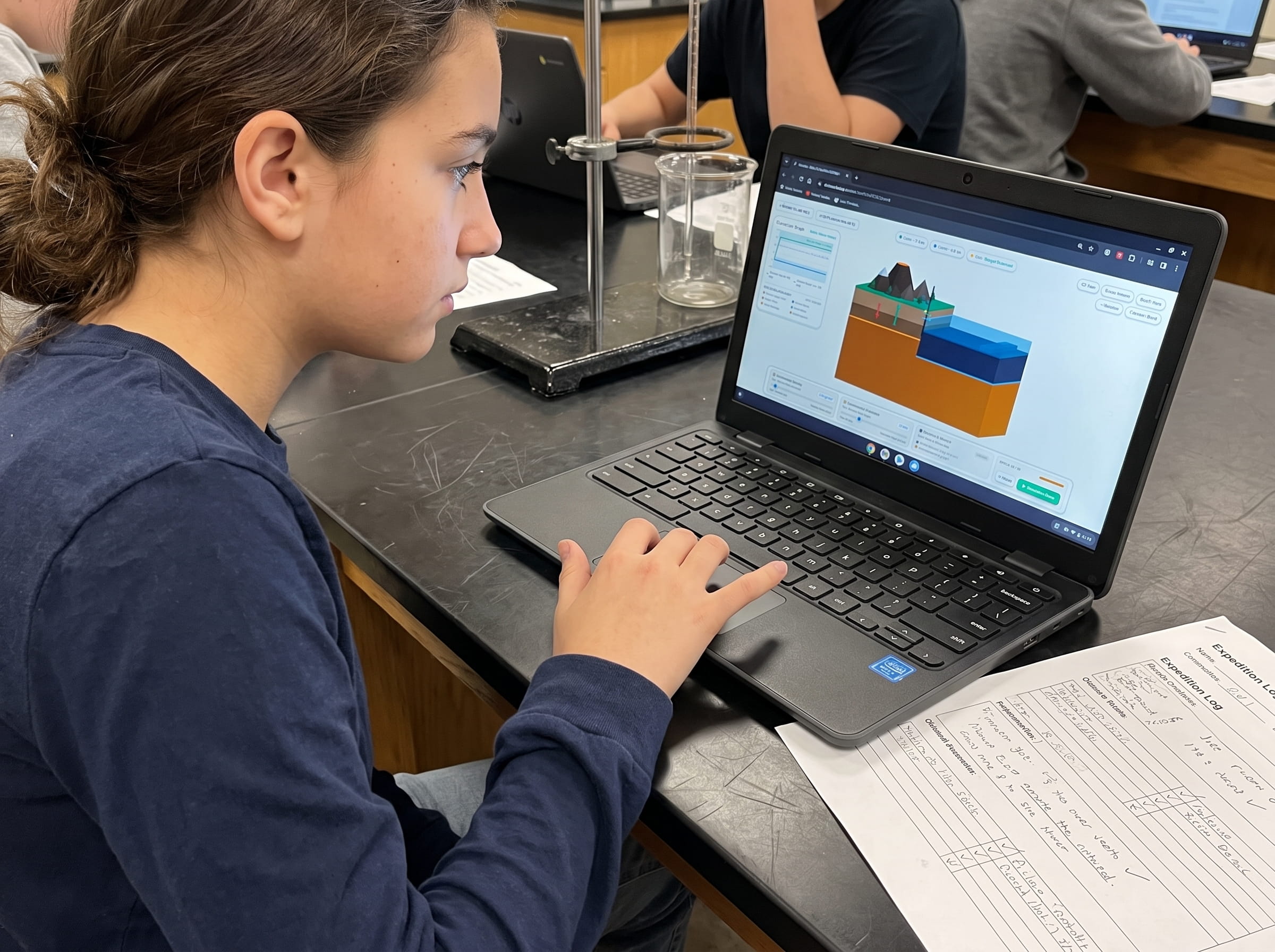
In our dual-format Earth Science curriculum, students open their printable Volcano Island Expedition Science Journal to Mission 08. On a coordinate graph with Altitude on the vertical axis (0 to 30 km) and Density on the horizontal axis, students draw Earth's standard atmospheric density gradient.
Next, students plot the bulk density curve of an ascending volcanic plume. They highlight the three zones: the Gas Thrust Zone (dense jet propelled by decompression), the Convective Thermal Chimney (light plume rising through buoyant lift), and the Neutral Buoyancy Level (where plume density equals stratospheric density, forcing lateral umbrella spreading). Calculating these boundaries by hand cements why volcanic ash affects aviation and global climate.
Prompt for students: Using your atmospheric density graph, explain why an eruption column stops rising at 20 kilometers altitude and spreads sideways like an umbrella. Why are commercial airplanes strictly prohibited from flying within hundreds of miles of an active plinian cloud?
Frequently Asked Questions About Plinian Columns and Level 08
Answers to common questions from middle school science educators, homeschool parents, and students exploring explosive volcanism and atmospheric dynamics.
What actually is volcanic ash, and why isn't it soft like wood ash?
Why are commercial jetliners in extreme danger from volcanic ash clouds?
What is the physical difference between a pyroclastic flow and a lahar?
What is the exact win condition for Volcano Island Level 8?
How does Level 8 transition into Level 9 (Caldera Collapse)?
Related Earth Science Units & Simulation Lab Resources
Continue your middle school Earth and Space science exploration with these curriculum-aligned resources:
Review crustal buoyancy in our crustal buoyancy isostasy simulation Level 1 guide.
Explore deep thermal circulation in our mantle convection tectonics simulation Level 2 guide.
Discover seafloor spreading in our seafloor spreading divergent boundary simulation Level 3 lab.
Investigate subduction abysses in our subduction zones deep trench simulation Level 4 article.
Explore subterranean magma generation in our flux melting magma chamber simulation Level 5 guide.
Study effusive basalt rivers in our shield volcano basaltic lava simulation Level 6 lab.
Examine viscous composite cones in our composite volcano silica viscosity simulation Level 7 guide.
Review complete homeschool science options in our earth science homeschool curriculum guide.
Set up student accounts with zero student logins on our educator dashboard.
24 pages of printable isostatic buoyancy calculation tables, paleomagnetic zebra stripe rulers, and seismogram triangulation exercises designed for grades 4 to 8.
DOWNLOAD EXPEDITION LOGBOOK (PDF)Level 8 Plinian Eruption Column & Gas Decompression Journal (PDF)
A printable 24-page Volcano Island Expedition Science Journal featuring structured pre-run inquiry hypotheses, plinian column altitude vs gas percentage coordinate graphs, and umbrella cloud spreading calculation worksheets.