The Open-and-Go Solution: Why Daily Lesson Plans Eliminate Homeschool Burnout
One of the greatest challenges in homeschooling science is the daily planning burden. Parents spend hours hunting down disconnected printable worksheets, gathering obscure laboratory supplies, and trying to align mismatched grade-level materials.
When lessons lack a structured daily progression, science often gets pushed to the back burner or reduced to rushed multiple-choice comprehension drills.
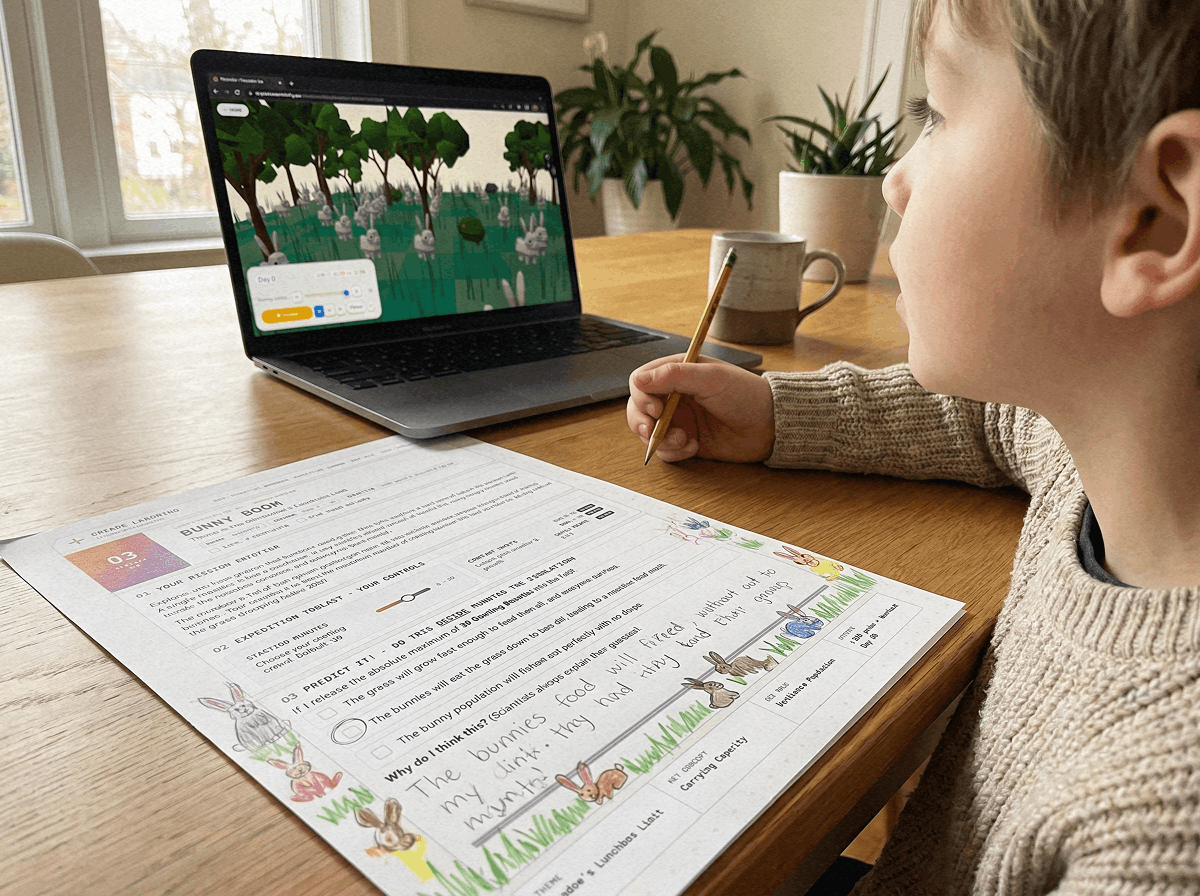
An open-and-go daily lesson plan solves this friction. By structuring each morning into a predictable 30-minute block (a 5-minute inquiry question, a 10-minute 3D digital trial, and a 10-minute written logbook reflection), parents can deliver a rigorous, NGSS-aligned STEM unit with zero advance prep.
An effective daily science lesson plan follows a structured 4-step sequence: (1) 5-min Central Inquiry Question, (2) 5-min Written Prediction, (3) 10-min 3D Simulation Trial, and (4) 10-min Data Logging & Reflection.
The Complete 10-Day Daily Lesson Plan Matrix (Missions 1 to 10 Breakdown)
Here is the complete day-by-day lesson roadmap covering 10 comprehensive ecology missions for grades 3-8:
| Day & Mission | Core Scientific Concept | Interactive 3D Simulation Run | Student Journal Task |
|---|---|---|---|
| DAY 1Day 1: Mission 01 | Solar Energy & Photosynthesis | Adjust sunlight and rain sliders to measure grass biomass growth | Log initial abiotic variables and color the primary producer energy flow chart |
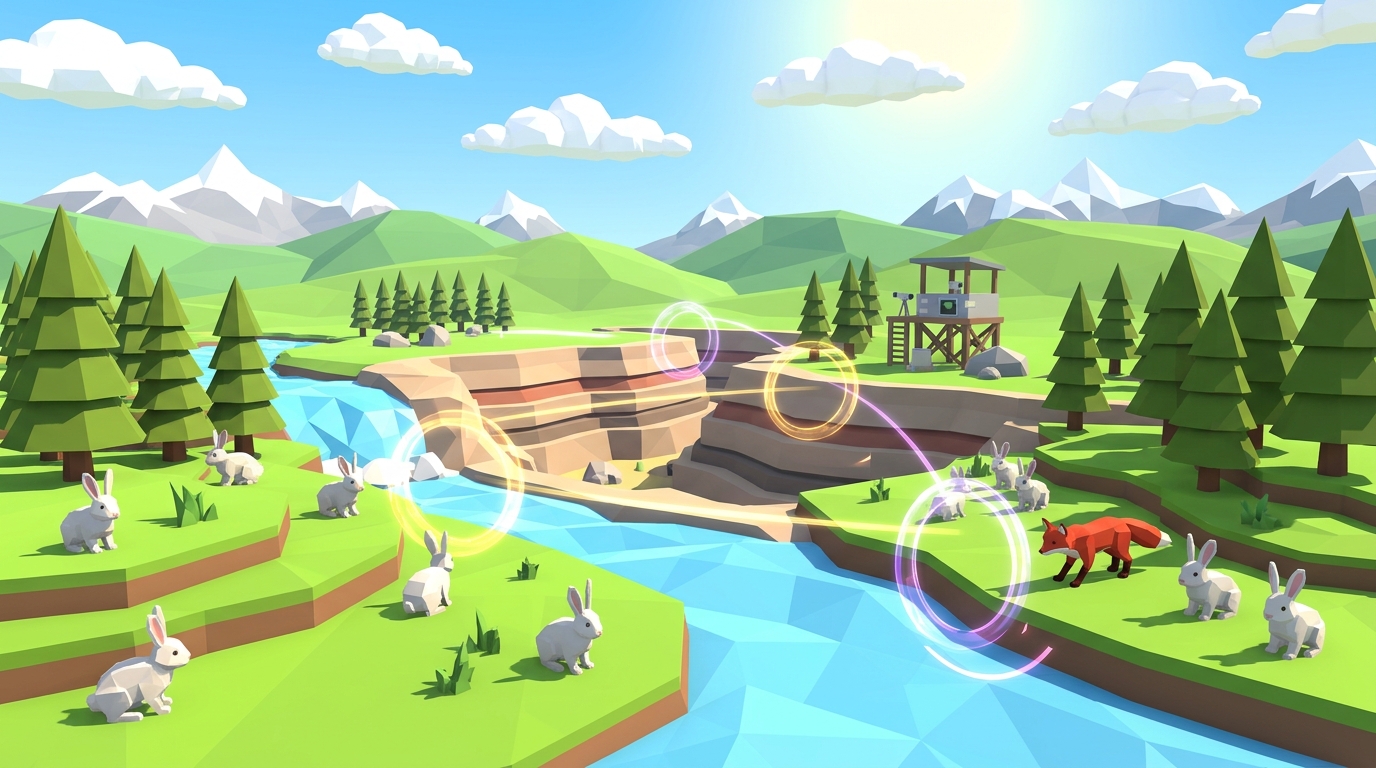
| DAY 2Day 2: Mission 02 | Herbivores & 10% Energy Rule | Introduce rabbits and track calorie consumption versus plant growth | Draw directional food chain arrows showing energy flow from producers to herbivores |
| DAY 3Day 3: Mission 03 | Carrying Capacity & Resource Limits | Trigger a population boom with 50 rabbits and watch meadow collapse | Plot daily population numbers on coordinate grid; calculate carrying capacity plateau |
| DAY 4Day 4: Mission 04 | Apex Predators & Trophic Cascades | Add gray wolves to control deer overgrazing and restore streamside vegetation | Complete the Yellowstone trophic cascade flowchart and identify keystone species |
| DAY 5Day 5: Mission 05 | Dynamic Equilibrium & Oscillations | Adjust terrain hiding bushes to balance predators and prey for 60 virtual days | Plot oscillating Lotka-Volterra predator-prey curves by hand in lab notebook |
| DAY 6Day 6: Mission 06 | Abiotic Stressors & Severe Drought | Cut rainfall to 10% to simulate a 3-month environmental drought crisis | Identify limiting abiotic factors and record vegetation recovery timelines |
| DAY 7Day 7: Mission 07 | Biodiversity & Ecosystem Resilience | Compare monoculture vs multi-species grasslands under disease stress | Write a comparative analysis on why biodiversity buffers ecological collapse |
| DAY 8Day 8: Mission 08 | Ecological Succession & Soil Regeneration | Observe barren rock terrain gradually colonize with moss, grass, and shrubs | Map primary versus secondary ecological succession stages in field notebook |
| DAY 9Day 9: Mission 09 | Human Impact & Habitat Fragmentation | Build roads and fences through the digital biome to analyze wildlife corridors | Design an environmental mitigation plan to restore broken migration corridors |
| DAY 10Day 10: Mission 10 | Capstone Investigation & Portfolio Review | Formulate an original hypothesis in the open sandbox and run 3 controlled trials | Complete the "My Best Mistake" reflection and sign the Certificate of Mastery |
How to Adapt the 10-Day Plan as a 10-Week Semester Spine or Summer Camp
This unit plan is highly flexible and easily adapts to your family's academic schedule:
Option A: 2-Week Intensive Unit Study (1 Mission Per Day). Perfect for focused science blocks or summer STEM camps. Students complete one mission every morning for two consecutive weeks.
Option B: 10-Week Semester Spine (1 Mission Per Week). The ideal rhythm for year-round homeschooling. Run the core simulation trial on Tuesday, conduct an outdoor nature study or library reading on Thursday, and complete the journal synthesis on Friday.
Option C: Co-op or Multi-Age Family Workshop. Use the central 3D simulation on a living room TV or projector for a group demonstration, while siblings complete differentiated primary, elementary, or middle school journal sheets.
For more curriculum pacing ideas, explore my companion guides on 30-minute homeschool science routine, family style science curriculum, affordable homeschool curriculum, and homeschool science portfolio guide.
Frequently Asked Questions About Free Daily Lesson Plans
Common questions from homeschool parents and co-op leaders.
What materials do I need to complete the 10 daily lesson plans?
Does this 10-day lesson plan satisfy state homeschool science requirements?
Can this curriculum be used with multiple children of different ages?
Are the daily lesson plans and 10 simulation missions 100% free?
Start Day 1 Free in 3D
Launch your open-and-go 10-day ecology unit today.
Start Level 1 instantly in your browser with zero registration. Unlock all 10 simulation missions and download the complete 24-page Expedition Science Journal 100% free with email.
Step inside Level 01 to begin Mission 1 of your free 10-day homeschool science unit.
START LEVEL 1 FREE10-Day Daily Lesson Plan Pacing Guide & 24-Page Journal (PDF)
Complete open-and-go daily lesson schedules, discussion prompts, student mission sheets, and teacher answer keys.