The Silent Tension: Why Tectonic Plates Don't Slide Like Ice
In popular imagination, earthquakes strike without warning, like lightning bolts from a clear sky. In the language of geophysics, however, an earthquake is merely the final, audible punctuation mark at the end of a long, silent sentence. For decades, centuries, or even millennia before a major tremor, tectonic forces are continuously charging the crust with mechanical energy.
Consider California's legendary San Andreas Fault, a 1,200-kilometer transform boundary where the Pacific Plate slides northwest past the North American Plate at an average rate of 35 millimeters per year. If rocks were as slick and frictionless as wet ice cubes, the two landmasses would glide past each other in continuous, polite silence. But tectonic plates are composed of jagged, crystalline granites, basalts, and sandstones under immense lithostatic confining pressure.
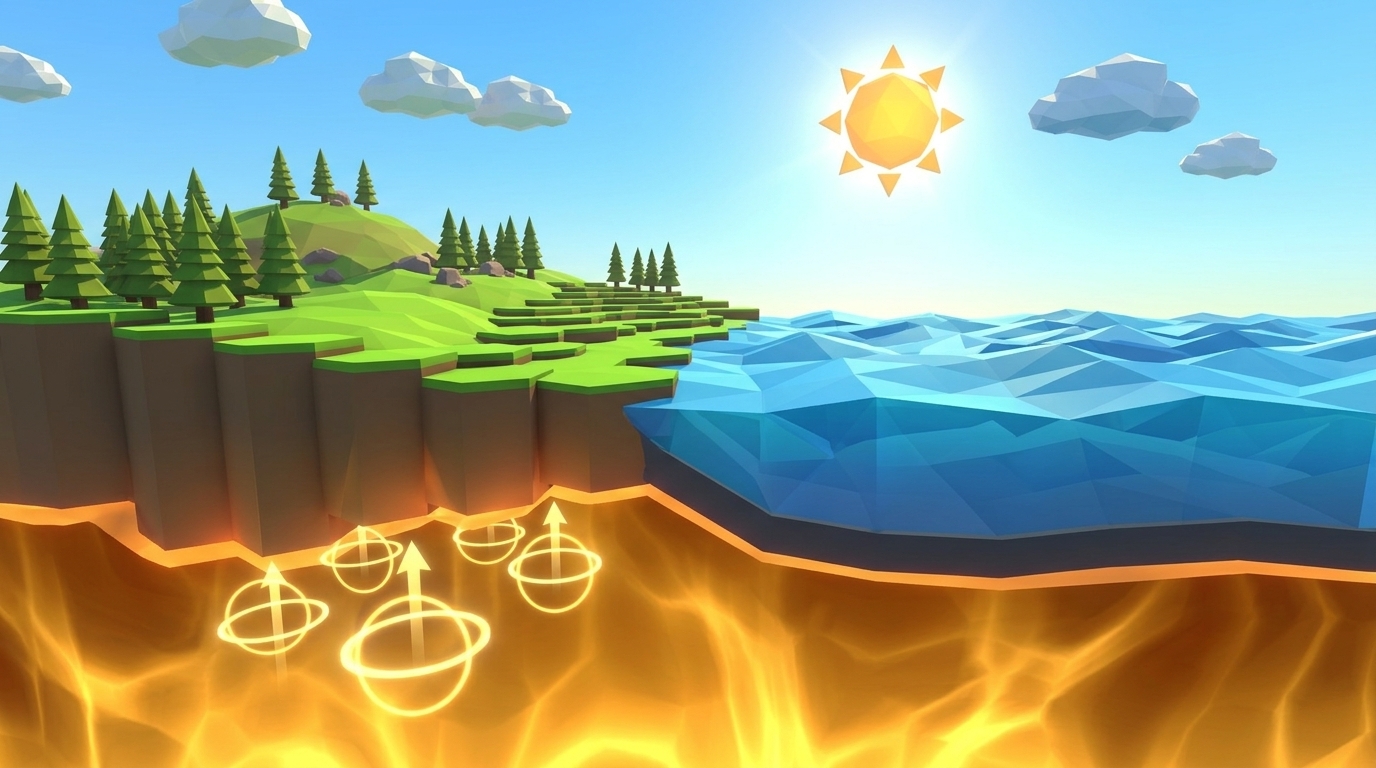
At the microscopic scale, fault surfaces are covered in jagged asperities: interlocking mineral teeth that bite into one another. These asperities generate colossal static friction that halts all movement along the upper 15 to 20 kilometers of the fault trace. The surface fault becomes locked. Yet hundreds of kilometers deeper in the plastic asthenosphere, plate motion never stops. The deep conveyor keeps driving forward, forcing the brittle crustal blocks on either side of the locked fault to warp, shear, and bend like a drawn archer's bow.
This foundational principle is known as Elastic Rebound Theory, formulated by American geologist Harry Fielding Reid after examining surface ruptures from the devastating 1906 San Francisco earthquake. In Level 11 of Volcano Island, students explore this invisible buildup, taking direct control of rock rigidity, shear rates, and frictional thresholds to model how mechanical strain stockpiles inside solid rock.
The Three Simulation Variables: Calibrating Friction, Shear & Rigidity in Level 11
To clear Level 11, students must prevent premature energy leakage while accumulating at least 8.0 Megapascals (MPa) of elastic shear strain energy across 50 simulation epochs. The interactive laboratory exposes three critical parameters:
| Simulation Variable | Unit / Range | Baseline / Novice Setting | Intended Target Window | Physical Effect in 3D Engine |
|---|---|---|---|---|
| Fault Friction Coefficient | 0.10 to 1.0 (dimensionless) | 0.20 (Default) | 0.75 to 0.85 (Target: 0.80) | Governs the shear strength threshold required to initiate slip along the fault plane. Low friction allows continuous, silent fault creep; high friction locks the plates, enabling maximum strain accumulation. |
| Tectonic Shear Rate | 1.0 to 10.0 cm/year | 2.0 cm/year (Default) | 4.5 to 6.0 cm/year (Target: 5.0) | Represents the velocity of deep convective plate drive. Higher shear rates pump strain energy into the locked crust more rapidly, raising the crimson stress curve toward the 8.0 MPa goal. |
| Rock Elastic Modulus / Rigidity | 10 to 80 GPa | 25 GPa (Default) | 50 to 60 GPa (Target: 55) | Controls the shear stiffness (Hooke's modulus) of the crustal rock. High rigidity allows the rock mass to store massive elastic energy without ductile crumbling or plastic deformation. |
Fault Creep vs. Locked Rupture: The Two Destinies of a Transform Boundary
Not all sections of a transform fault behave identically. Depending on mineralogy, pore-fluid pressures, and normal stress, fault segments divide into two distinct behavioral regimes:
The Locked Fault (Seismic Stick-Slip: e.g., Fort Tejon & Coachella Valley)
Maximum elastic strain storage culminating in catastrophic earthquakes
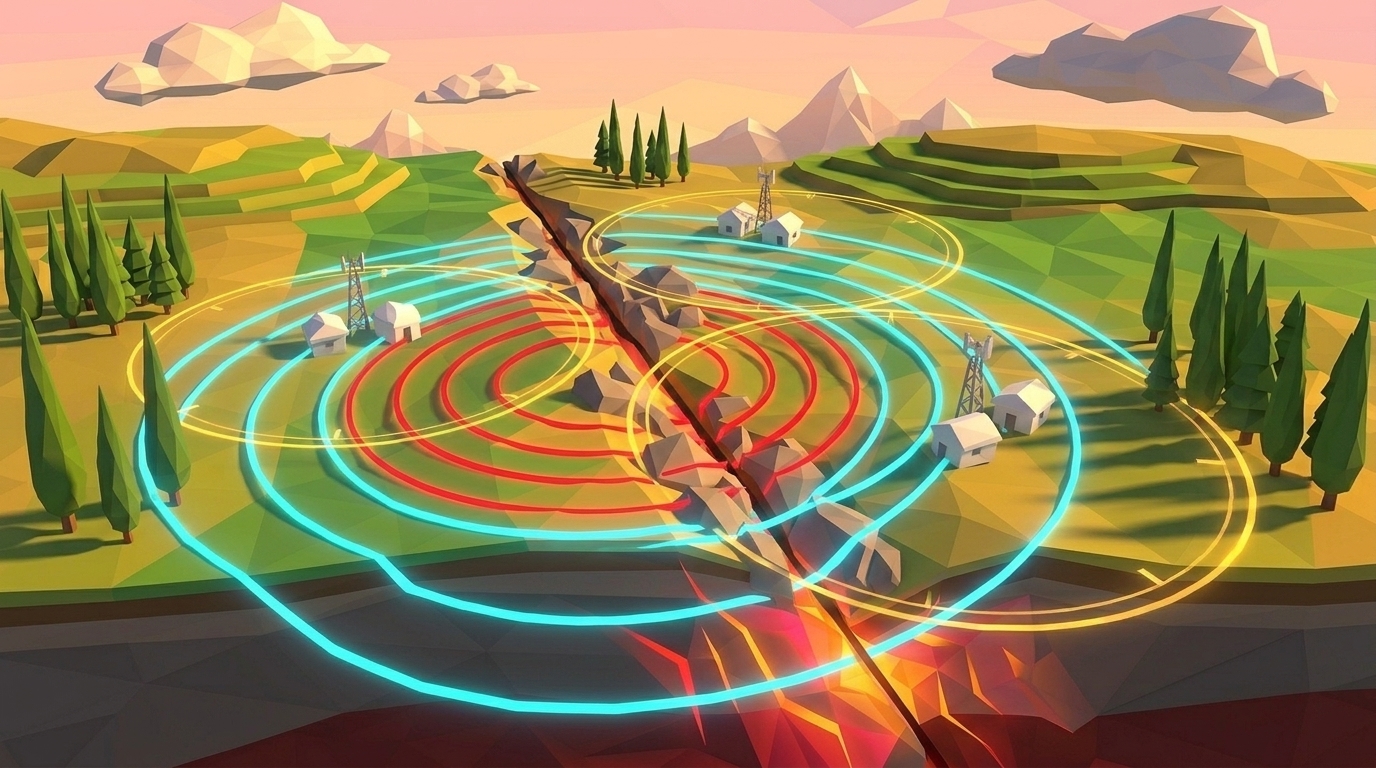
Locked segments experience high static friction (greater than 0.75), completely welding the fault plane shut for centuries. Surface displacement is strictly zero, but the crust miles away continues moving, warping roads, fence lines, and citrus groves into dramatic S-curves. When accumulated shear stress finally exceeds the frictional lock, all stored energy releases violently in seconds, generating high-magnitude earthquakes (M 7.5 to 8.0).
- ✓Zero surface slip; 100% elastic strain accumulation
- ✓Creates visible curved S-warp distortion across roads and fences
- ✓Stores immense mechanical energy (upwards of 8 to 15 MPa)
- ✓Produces destructive catastrophic ruptures like 1906 San Francisco
The Creeping Fault (Aseismic Slip: e.g., Hollister & Central San Andreas)
Gradual, harmless plate displacement without major tremors
In creeping sections, fault friction is exceptionally low (below 0.30), often lubricated by talc-rich serpentinite gouge or pressurized subterranean hydrothermal fluids. The plates slide past each other smoothly and continuously at 25 to 30 millimeters per year. While sidewalks and curbstones in towns like Hollister, California slowly shear out of alignment, the fault never stores enough concentrated strain energy to trigger a catastrophic earthquake.
- ✓Continuous slow displacement with zero elastic energy buildup
- ✓Slowly offsets curbs, brick walls, and utility pipes over decades
- ✓Acts as a safety valve, releasing tectonic motion harmlessly
- ✓Demonstrates why low friction prevents major seismic disasters
Bend Solid Rock & Stockpile 8.0 MPa of Elastic Strain Energy in 3D
Calibrate Fault Friction Coefficient, Tectonic Shear Rate, and Rock Elastic Modulus in our real-time cutaway diorama. Lock opposing crustal blocks to warp orchard fences and country roads into S-curves, preventing premature fault creep across 50 simulation epochs. Zero sign-up, instant browser play.
The Physics of Elastic Deformation: How Fences, Roads, and Orchards Warp
How do geophysicists know a locked fault is dangerous if the ground is completely quiet? The secret lies in measuring the invisible spatial curvature of the surrounding terrain.
Imagine building a perfectly straight wooden fence across a locked fault in the year 1900. Five miles to the west, the Pacific Plate moves northwest by 35 millimeters each year. Five miles to the east, the North American plate stays still. Because the fault itself is welded shut by friction, the fence directly on the fault line does not move at all. Instead, the fence posts on either side gradually bow outward into a smooth, elegant S-curve.
In the real world, early 20th-century surveyors noticed this phenomenon when re-measuring triangulation networks across California orchards. Today, satellite radar interferometry (InSAR) and continuous GPS monitoring stations track this crustal bowing with sub-millimeter precision. When geologists observe a wide zone of crustal bending centered on a motionless fault trace, they know with mathematical certainty that an elastic spring is being compressed, waiting for the trigger.
Systems Thinking & Ormanci Competency: Stock Accumulation of Elastic Energy
Level 11 directly cultivates the Ormanci (2026) systems thinking competency: Stock Accumulation of Elastic Potential Energy. In conventional instruction, middle school students frequently view physical systems as simple, immediate cause-and-effect pairs: "a force is applied, and an object moves immediately."
In geological mechanics, however, resistance introduces a critical stock-and-flow delay. The tectonic plate drive is a continuous inflow of mechanical work. Frictional resistance acts as a closed valve on the outflow. Because outflow is zero, the stock: accumulated shear strain energy inside the crystal lattices of deep granite: builds up steadily over time. Only when the stock reaches a non-linear threshold (the static failure limit) does the valve blow open in a violent pulse of seismic waves.
By observing the live coordinate graph in Level 11: watching the crimson strain curve rise toward 8.0 MPa while keeping the yellow creep displacement flat at zero: students develop an intuitive mastery of delayed feedback loops and non-linear system thresholds.
Common Student Misconceptions in Middle School Geology
Educators frequently address three prevalent misconceptions when teaching transform faults and earthquakes:
1. Misconception: "A quiet fault where no earthquakes have occurred for a hundred years is the safest place to live." Reality: In seismology, an eerily quiet segment of an active plate boundary is known as a seismic gap. Because deep tectonic plates never stop moving, a lack of earthquakes indicates that the fault is firmly locked and accumulating dangerous elastic strain. The longer a fault stays quiet, the larger and more violent the eventual rupture will be.
2. Misconception: "Rocks are completely rigid and brittle; they cannot bend without immediately breaking." Reality: Solid rock is remarkably elastic under the high confining pressures found 5 to 15 kilometers beneath the surface. Deep granitic rock can bend and warp by several meters across a regional zone before reaching its ultimate shear failure point.
3. Misconception: "Earthquakes happen because tectonic plates suddenly speed up or crash into each other." Reality: Plate velocities are remarkably steady, driven by slow mantle convection at rates of 2 to 10 centimeters per year. What changes abruptly is not the plate speed, but the mechanical state of the fault: from static friction lock to dynamic sliding failure.
Teacher Lesson Plan: The 45-Minute Locked Fault & Foam Block Lab
This structured lesson plan integrates tactile modeling with digital simulation in Volcano Island Level 11:
Kinesthetic Friction & Bow Demonstration (5 mins)
Press two rough sandpaper blocks together firmly and attempt to slide them horizontally. Note how the paper grabs and resists motion until you apply heavy force. Next, bend a wooden ruler or bow, showing students how mechanical energy is stored invisibly in the curved wood without the ends slipping.
Pre-Run Hypotheses & S-Curve Predictions (10 mins)
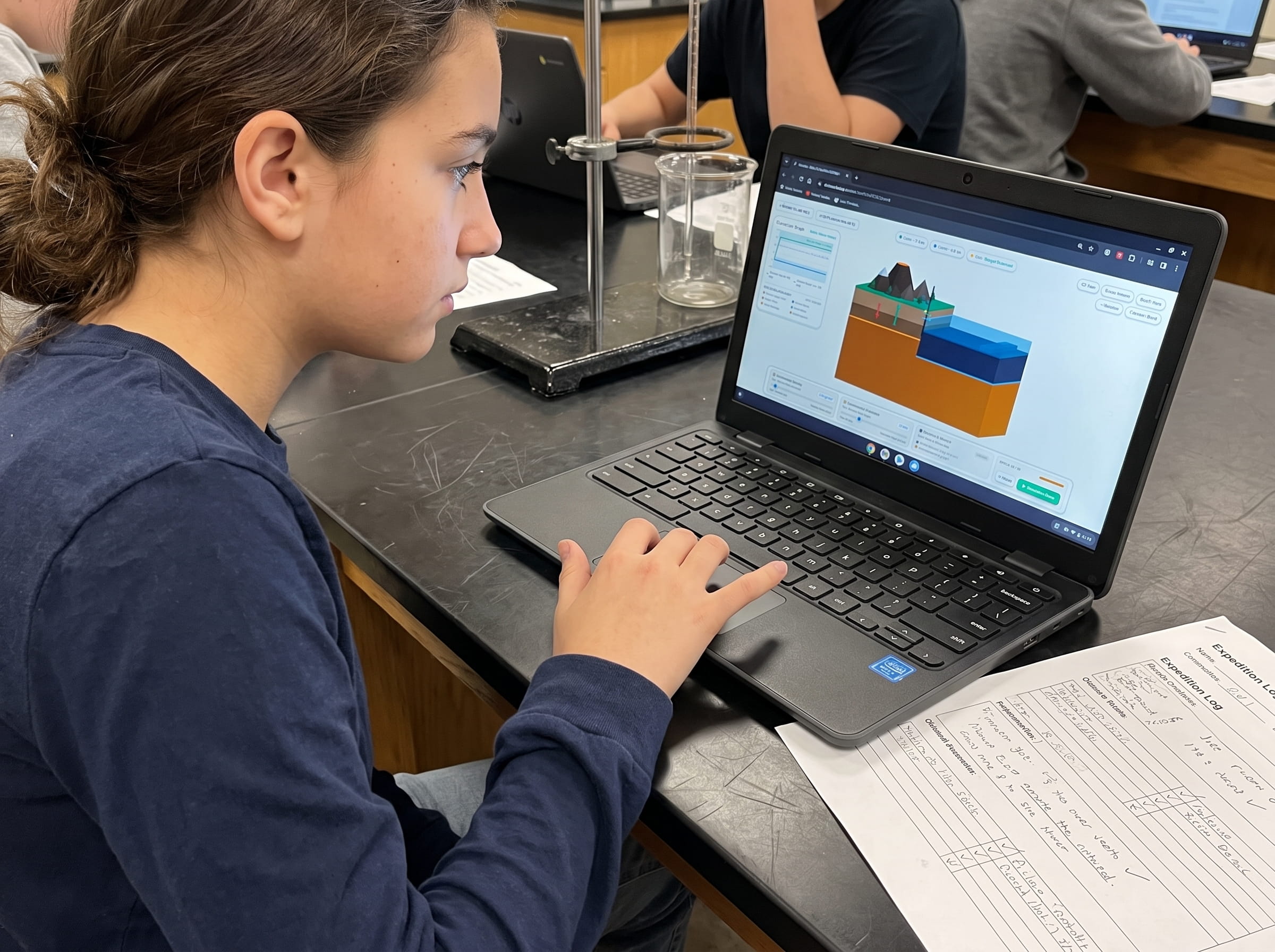
Have students launch Level 11 on classroom laptops. Direct them to formulate their hypothesis: If fault friction is left at default (0.20), will the rock store enough energy for an earthquake, or will it leak away as creep? What will happen to straight orchard fences when friction is set to 0.80?
Interactive Parameter Calibration in Volcano Island (20 mins)
Students calibrate Fault Friction Coefficient to 0.80, Rock Elastic Modulus to 55 GPa, and Tectonic Shear Rate to 5.0 cm/year. They watch the road markings and fence lines warp into visible S-curves while monitoring the crimson strain curve climb past 8.0 MPa across 50 simulation epochs.
Strain Graph Analysis & Field Logbook Reflection (10 mins)
Students sketch the warped S-curve fence lines in their field logbook, record the final stored strain energy (in MPa), and explain why creeping faults in Hollister rarely produce catastrophic earthquakes compared to locked faults in Southern California.
Testing Handbook & Cheat Sheet: How to Clear Level 11
Use this calibrated testing guide to assist students in achieving the Level 11 benchmark:
Engine Configuration: Fault Trace Length: 50 km | Strain Target: >= 8.0 MPa without slip | Simulation Epochs: 50 epochs.
Winning Calibration Parameters:
Fault Friction Coefficient: Set slider to 0.75 to 0.85 (Target: 0.80). This provides sufficient static shear resistance to clamp the fault plane shut, completely suppressing premature fault creep.
Tectonic Shear Rate: Set slider to 4.5 to 6.0 cm/year (Target: 5.0 cm/year). This drives continuous mechanical deformation into the crustal blocks at a realistic plate tectonic velocity.
Rock Elastic Modulus / Rigidity: Set slider to 50 to 60 GPa (Target: 55 GPa). This ensures the granitic crust remains elastically stiff, storing mechanical energy without crumbling into plastic gouge clay.
Common Failure Modes:
Fault Creep Leak: Setting Friction below 0.35 allows plates to slip smoothly and continuously, venting energy as aseismic creep and leaving stored strain near zero.
Plastic Gouge Failure: Setting Rock Rigidity below 30 GPa causes the rock along the fault to crush into ductile gouge, absorbing energy through permanent deformation rather than elastic strain.
Frequently Asked Questions (FAQ)
Common questions educators, homeschool parents, and students ask about locked faults and earthquake physics:
What is the difference between static friction and dynamic friction on a fault?
What is a seismic gap, and why does it alarm geologists?
Can humans lubricate faults by injecting water to release earthquakes safely?
How does Level 11 lead into Level 12 (The Great Rupture)?
Related Earth Science Units & Simulation Lab Resources
Continue your middle school Earth and Space science journey with these companion simulation guides:
Review crustal buoyancy in our crustal buoyancy isostasy simulation Level 1 guide.
Explore deep thermal circulation in our mantle convection tectonics simulation Level 2 guide.
Discover seafloor spreading in our seafloor spreading divergent boundary simulation Level 3 lab.
Investigate subduction abysses in our subduction zones deep trench simulation Level 4 article.
Explore subterranean magma generation in our flux melting magma chamber simulation Level 5 guide.
Study effusive basalt rivers in our shield volcano basaltic lava simulation Level 6 lab.
Examine viscous composite cones in our composite volcano silica viscosity simulation Level 7 guide.
Model supersonic gas decompression in our volcanic eruption plume gas simulation Level 8 guide.
Examine caldera collapses in our caldera collapse crater lake simulation Level 9 lab.
Explore mantle plumes in our hotspot island chain mantle plume simulation Level 10 guide.
Review complete homeschool science options in our earth science homeschool curriculum guide.
Set up student accounts with zero student logins on our educator dashboard.
24 pages of printable isostatic buoyancy calculation tables, paleomagnetic zebra stripe rulers, and seismogram triangulation exercises designed for grades 4 to 8.
DOWNLOAD EXPEDITION LOGBOOK (PDF)