The Day the Sun Grew Pale: The 1816 Year Without a Summer
In April 1815, on the Indonesian island of Sumbawa, a colossal stratovolcano named Mount Tambora unleashed the most powerful volcanic explosion in recorded human history. Detonating with a Volcanic Explosivity Index of VEI 7, the eruption blasted over 100 cubic kilometers of rock, pulverized pumice, and superheated gases into the atmosphere, creating a deafening roar heard more than 2,600 kilometers away.
Yet the true global shockwave was not acoustic; it was climatic. Fourteen months later, in June 1816, residents of New England, eastern Canada, and western Europe awoke to a surreal nightmare. Instead of summer warmth, temperatures plunged below freezing. Six inches of heavy snow blanketed Maine and Massachusetts in June; river ice formed in Pennsylvania in July; and killing frosts wiped out corn, rye, and wheat crops across the northern hemisphere.
Historical chronicles remember 1816 as "The Year Without a Summer", or "Eighteen Hundred and Froze to Death." Food prices spiked by 800%, causing bread riots in France and Britain, widespread famine, and typhus epidemics. In Switzerland, relentless cold rain trapped teenage author Mary Shelley indoors at Lake Geneva, inspiring her to write the chilling gothic masterpiece Frankenstein.
How could a single volcanic blast on a tropical island south of the equator cause snowstorms in New York and crop failures across Europe more than a year later? The answer lies in the atmospheric physics of sulfur gas and the delicate radiative balance of our planet.
Volcanic ash does not cause multi-year ice ages. Heavy ash flakes fall out of the sky in days. Global climate cooling is driven entirely by invisible sulfur dioxide gas that breaches the 12-kilometer tropopause and transforms into trillions of microscopic airborne mirrors.
The Chemistry of Global Dimming: From SO₂ Gas to Stratospheric Mirrors
When teaching Earth systems in middle school science, textbooks often describe "volcanic dust clouds blocking the sun." This explanation creates a fundamental misunderstanding. Volcanic ash (tephra) is made of dense silicate rock particles ranging from 10 to 2,000 microns in size. Because silicate rock has high mass, Earth's gravity rapidly pulls coarse ash out of the sky within 48 to 72 hours, while fine ash settles within two to three weeks. Ash causes terrifying daytime darkness near the volcano, but it cannot sustain global climate cooling for years.
The true driver of volcanic winters is invisible sulfur dioxide gas (SO₂). During violent explosive eruptions, volatile-rich magma releases tens of millions of tons of sulfur dioxide. What happens next depends entirely on one critical atmospheric boundary: the tropopause.
The lower atmosphere (the troposphere, from sea level to roughly 12 kilometers altitude) is where all everyday weather happens. It is filled with convection, moisture, clouds, and rainfall. When SO₂ gas is released below 12 km (as in small eruptions or effusive basalt fissures), rainclouds absorb the sulfur and wash it out of the sky within five to seven days as localized acid rain. This phenomenon is known as tropospheric rainout.
However, when an ultra-plinian eruption column explodes upward at supersonic speeds, its buoyant momentum punches straight through the 12-kilometer tropopause ceiling into the stratosphere (12 to 50 km). The stratosphere is an entirely different world: it is extremely dry, stably stratified, and completely free of clouds and rain. There is zero weather to wash sulfur out of the sky.
Trapped in the calm stratosphere, SO₂ gas undergoes a photochemical chain reaction over 30 to 60 days. Sunlight and ultraviolet radiation break down trace water vapor into reactive hydroxyl radicals (OH), which oxidize sulfur dioxide into sulfuric acid (H₂SO₄). These acid molecules rapidly nucleate into billions of sub-micron liquid aerosol droplets (0.2 to 0.8 micrometers in diameter).
Optically, these microscopic sulfate droplets match the exact wavelength of visible solar radiation (0.4 to 0.7 micrometers). They act as a planetary sunscreen: reflecting 1% to 3% of incoming sunlight back into space while absorbing infrared radiation, warming the stratosphere while casting a cool shadow over the land and oceans below.
| Eruption & Year | Geographic Location | Injected SO₂ Mass | Plume Peak Altitude | Global Temperature Dip | Historical / Climate Impact |
|---|---|---|---|---|---|
| Coldest Historical AnomalyMount Tambora (1815) | Sumbawa, Indonesia | 28 to 32 Megatons | 32 to 43 km (Stratosphere) | -1.5°C (-2.7°F) | 1816 "Year Without a Summer", global crop failure and famine |
| Krakatoa (1883) | Sunda Strait, Indonesia | 15 to 20 Megatons | 28 to 35 km (Stratosphere) | -0.6°C (-1.1°F) | Fiery crimson sunsets worldwide, global barometric shockwaves |
| Mount Pinatubo (1991) | Luzon, Philippines | 17 to 20 Megatons | 35 km (Stratosphere) | -0.5°C (-0.9°F) | Satellite-tracked optical depth, temporarily masked global warming |
| Laki Fissure (1783) | South Iceland | 100+ Megatons | 9 to 13 km (Tropospheric) | Local severe anomaly | Persistent poisonous acid haze over Europe, extreme local winter freeze |
Atmospheric Jet Streams & Planetary Circulation: How the Veil Spreads
Why did Tambora (located 8 degrees south of the equator in Indonesia) cause blizzards in North America and Western Europe? The answer lies in planetary atmospheric circulation and high-altitude stratospheric winds.
Near the equator, intense equatorial solar heating powers the ascending branch of the Brewer-Dobson circulation. Air rises in the tropical troposphere, enters the lower stratosphere, and slowly migrates poleward toward both the Arctic and Antarctic before sinking in polar latitudes. When an eruption occurs within the tropical belt (between 20°N and 20°S, like Tambora, Krakatoa, and Pinatubo), high-speed stratospheric winds (60 to 100 km/h) wrap the sulfur gas around the equatorial belt within two to three weeks.
Over the following three to six months, the Brewer-Dobson circulation transports the growing aerosol veil outward into both the Northern and Southern Hemispheres, creating a uniform, planet-wide optical blanket. By contrast, volcanic eruptions at high latitudes (like Iceland or Alaska) generally trap their aerosols within the subpolar jet stream, restricting major cooling effects to the northern hemisphere.
Once established, how does a volcanic winter end? Because the stratosphere has no rain, sulfate aerosols cannot be washed away. Instead, they settle out through gravitational sedimentation and slow downward stratospheric subsidence over 18 to 36 months. Scientists measure this using stratospheric aerosol optical depth (AOD), which exhibits a natural exponential decay half-life of roughly 12 to 14 months before global temperatures return to baseline.
The Science Behind the Sliders: Level 16 Mission Handbook
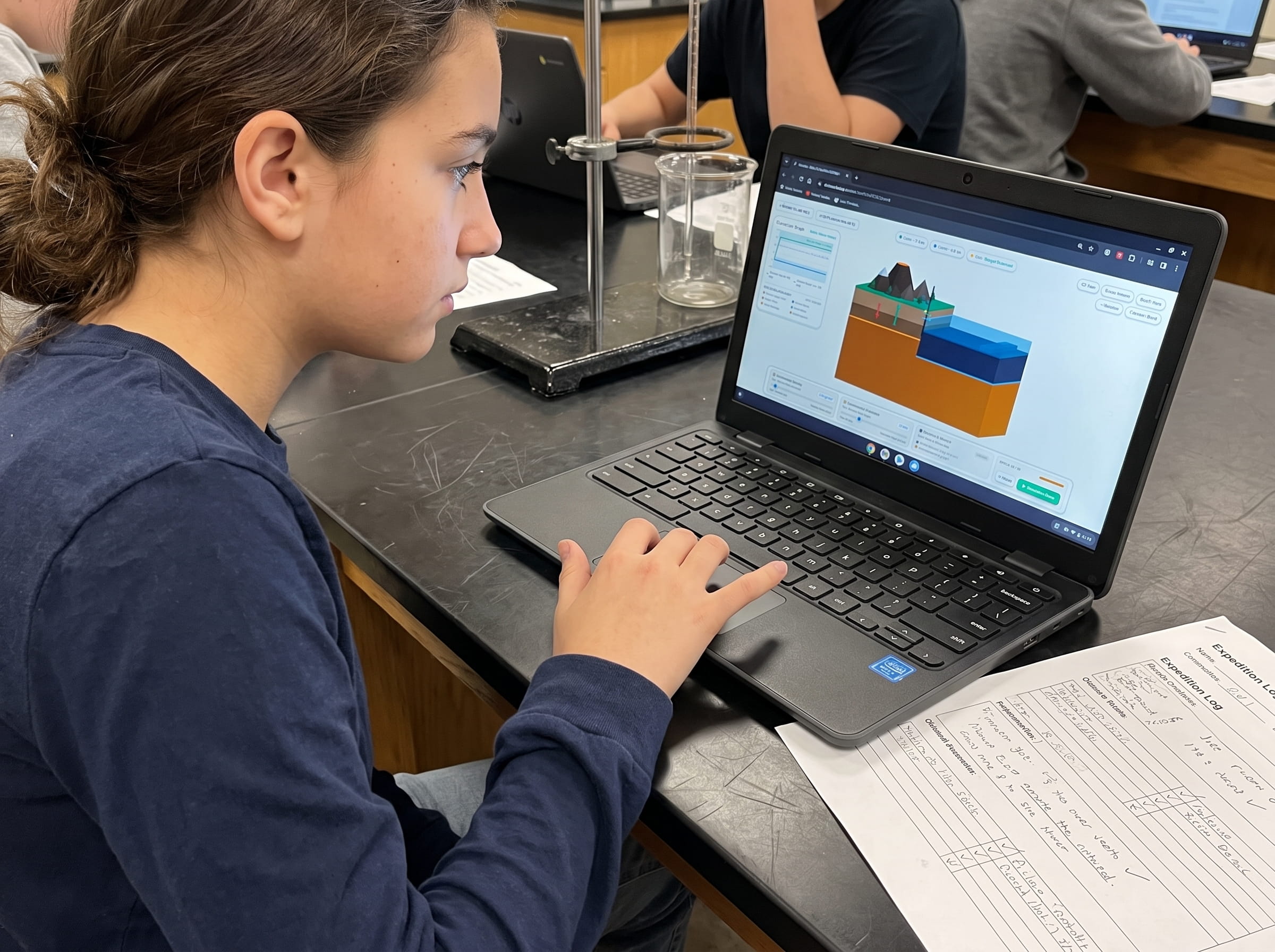
In Level 16: Volcanic Winter, students step into the planetary climatology command center. Instead of observing a local island, the simulation models an entire 3D global hemisphere with animated atmospheric layers and live radiative flux meters. The objective is to accurately recreate the 1815 Mount Tambora eruption, stabilizing a global cooling anomaly between -1.2°C and -1.8°C for 50 post-eruption months without triggering runaway glaciation.
Here is the scientific function of each simulation control slider in Level 16:
Injected SO₂ Gas Mass (Target: 26 to 32 Megatons)
Calibrates the total quantity of sulfur dioxide gas released by the explosive blast. Defaulting to a tiny 5 Megatons, the sulfur mass is too diffuse to alter planetary albedo, yielding zero measurable global cooling. Boosting sulfur mass into the historical Tambora range (26 to 32 Mt) produces sufficient aerosol optical depth to reflect 2% of incoming solar insolation. Beware: pushing SO₂ mass above 70 Megatons triggers extreme planetary cooling below -3.5°C, initiating dangerous runaway ice-albedo feedback loops.
Plume Injection Altitude (Target: 21 to 25 km)
Determines the vertical height reached by the eruption column. The simulation models a hard physical rainout boundary at 12 km (the tropopause). If sulfur is released below 12 km (such as the default 8 km), tropospheric rainstorms wash out all sulfur within 5 epochs, causing immediate mission failure. Injecting sulfur between 21 and 25 km places the gas firmly into the dry, cloudless stratosphere, ensuring long-term aerosol suspension and planetary dispersion.
Stratospheric Circulation Speed (Target: 60 to 75 km/h)
Controls the velocity of high-altitude jet streams distributing the aerosol veil across the hemisphere. At sluggish speeds below 30 km/h, the aerosol cloud remains clustered near the eruption site, causing extreme localized cooling while leaving the rest of the planet unaffected. Accelerating wind speed to 65 km/h ensures the sulfate veil encircles the hemisphere by Month 6, achieving uniform radiative dimming.
Level 16 Simulation: Stratospheric Aerosols & Climate Lab
Model the planetary climate aftermath of the 1815 Mount Tambora eruption. Calibrate SO₂ gas injection mass, stratospheric altitude, and planetary circulation speed to stabilize a -1.5°C global cooling anomaly without triggering runaway glaciation.
Step-by-Step Lab Protocol: Recreating the 1815 Tambora Winter
Follow this four-step testing protocol in the Level 16 simulation lab to calibrate sulfur mass, overcome tropospheric rainout, and achieve the target -1.5°C global cooling anomaly:
Observe Default Tropospheric Rainout
Launch Level 16 with default parameters (SO₂: 5 Mt, Altitude: 8 km, Circulation: 40 km/h). Click Play. Notice how the sulfur plume is immediately caught in gray tropospheric rain clouds. By Month 3, all sulfur has rained out as acid precipitation, the global temperature curve remains flat at 0.0°C, and the mission fails.
Breach the 12 km Tropopause Ceiling
Reset the simulation. Elevate the Injection Altitude slider from 8 km up to 23 km. This punches through the stormy lower atmosphere directly into the pristine, cloudless stratosphere where rain cannot reach.
Load Tambora-Scale Sulfur Mass
Increase the Injected SO₂ Mass slider from 5 Mt to 28 Megatons (the scientifically reconstructed sulfur output of Mount Tambora in 1815).
Accelerate Circulation and Sustain the 50-Month Winter
Increase Stratospheric Circulation Speed to 65 km/h. Press Play. Watch as the glowing aerosol veil spreads around the global diorama. By Month 6, stratospheric aerosol optical depth peaks, planetary albedo rises by 2.4%, and global temperatures dip to -1.5°C, sustaining stable volcanic winter conditions across the full 50-month evaluation period for a perfect score.
Frequently Asked Questions: Earth Science Curriculum FAQ
These five questions explore the complex dynamics of volcanic aerosol radiative forcing and planetary climate feedback for middle school science students:
Why doesn't volcanic ash cause multi-year global cooling?
Could a modern volcanic eruption reverse human-caused global warming?
What is the difference between a volcanic winter and an impact winter?
How do scientists know global temperatures from 1816 before satellites existed?
How does Level 16 lead into Level 17 (The Warning Network: Volcano Monitoring)?
Related Earth Science Units & Simulation Lab Resources
Continue your middle school Earth and Space science journey with these companion simulation guides:
Review crustal buoyancy in our crustal buoyancy isostasy simulation Level 1 guide.
Explore deep thermal circulation in our mantle convection tectonics simulation Level 2 guide.
Discover seafloor spreading in our seafloor spreading divergent boundary simulation Level 3 lab.
Investigate subduction abysses in our subduction zones deep trench simulation Level 4 article.
Explore subterranean magma generation in our flux melting magma chamber simulation Level 5 guide.
Study effusive basalt rivers in our shield volcano basaltic lava simulation Level 6 lab.
Examine viscous composite cones in our composite volcano silica viscosity simulation Level 7 guide.
Model supersonic gas decompression in our volcanic eruption plume gas simulation Level 8 guide.
Examine caldera collapses in our caldera collapse crater lake simulation Level 9 lab.
Explore mantle plumes in our hotspot island chain mantle plume simulation Level 10 guide.
Investigate locked transform faults in our locked fault elastic rebound simulation Level 11 guide.
Triangulate earthquake epicenters in our earthquake seismic waves triangulation simulation Level 12 guide.
Analyze open-ocean tsunami shoaling in our megathrust tsunami subduction simulation Level 13 guide.
Master circum-Pacific convergence networks in our ring of fire subduction arc simulation Level 14 guide.
Study primary ecological succession in our volcanic soil succession ash simulation Level 15 guide.
Review complete homeschool science options in our earth science homeschool curriculum guide.
Set up student accounts with zero student logins on our educator dashboard.
24 pages of printable isostatic buoyancy calculation tables, paleomagnetic zebra stripe rulers, and seismogram triangulation exercises designed for grades 3 to 8.
DOWNLOAD EXPEDITION LOGBOOK (PDF)Download Free Volcano Island Field Geologist Logbook (PDF)
24 pages of printable isostatic buoyancy calculation tables, paleomagnetic zebra stripe rulers, and seismogram triangulation exercises designed for grades 3 to 8.