The Sleeping Giants: When Hotspots Burn Beneath Continents
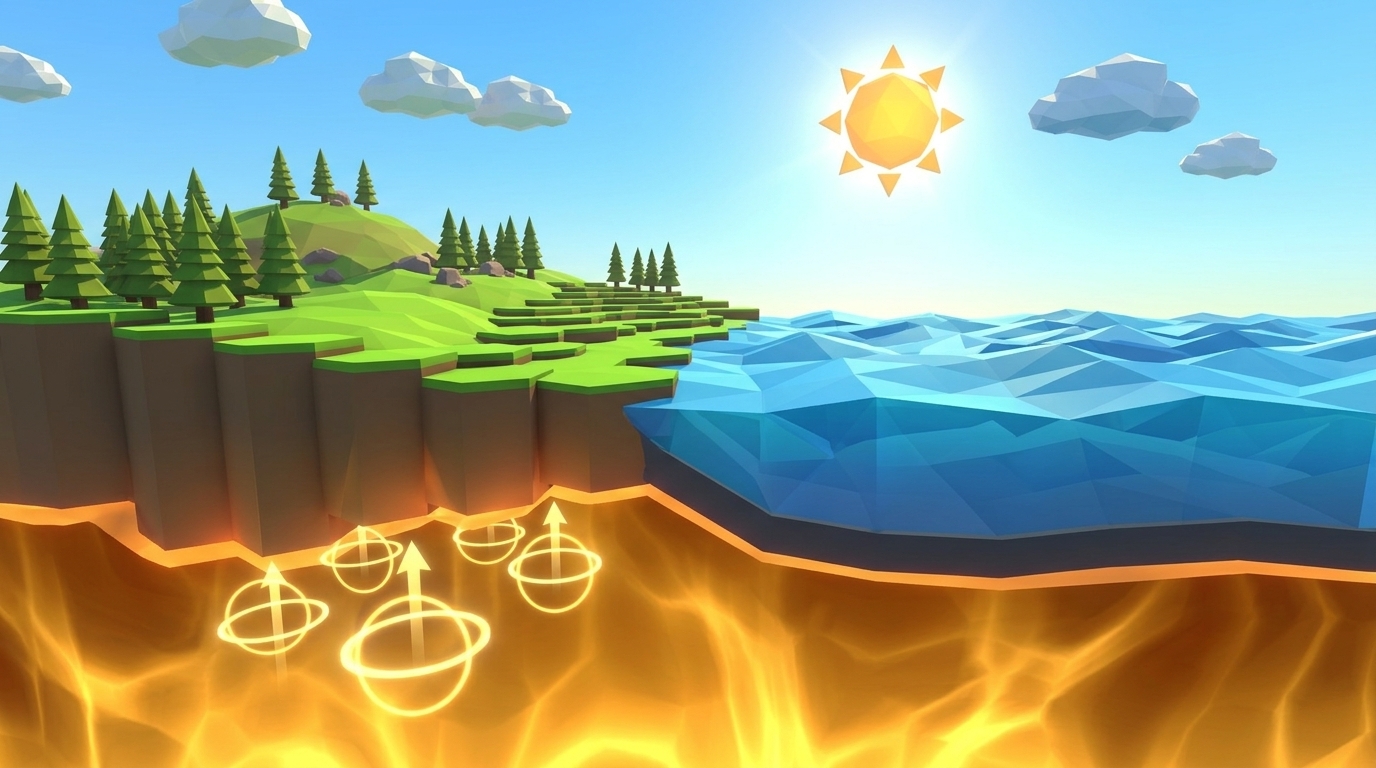
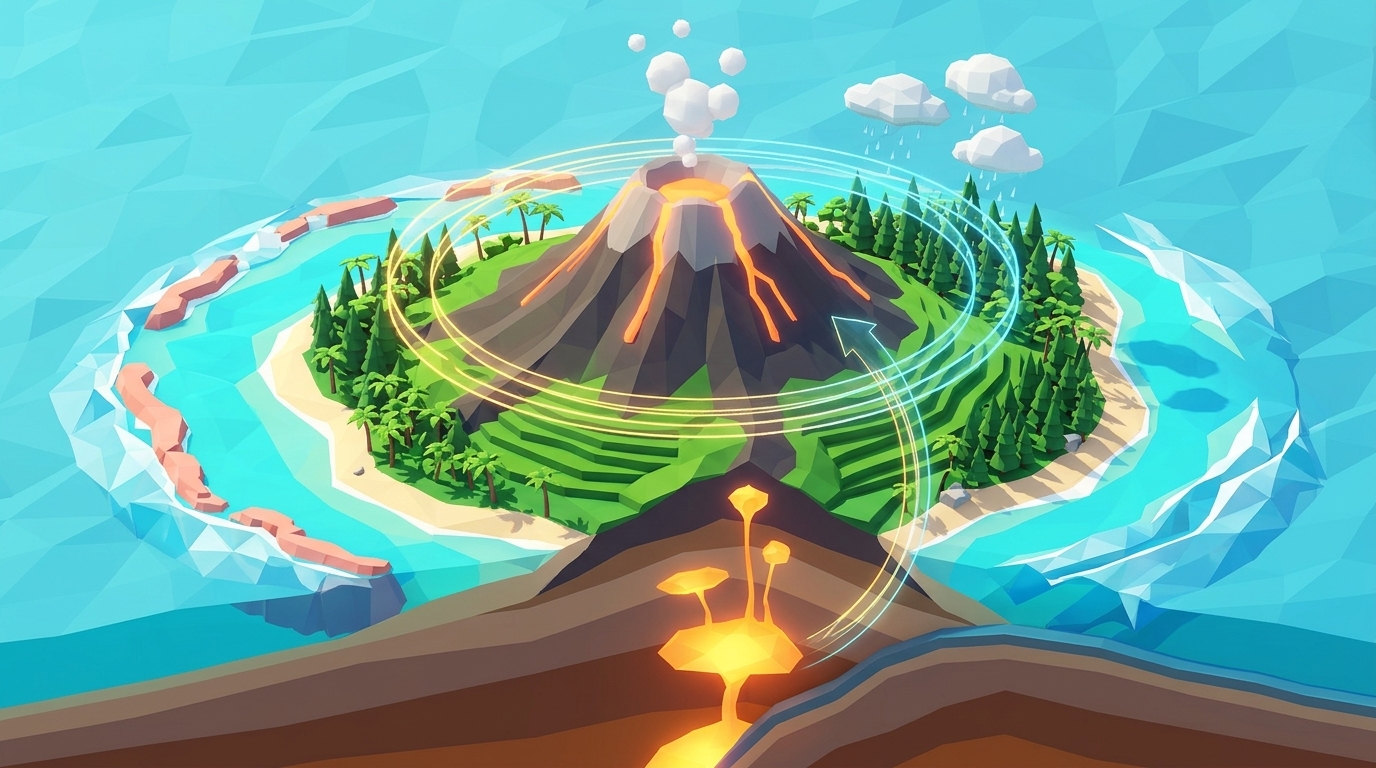
In earlier missions of Volcano Island, we explored oceanic hotspots like Hawaii. In the middle of the Pacific Ocean, a stationary thermal mantle plume burns directly through thin, dense oceanic basalt. Because the surrounding crust is mafic and thin (5 to 7 kilometers), the rising basaltic magma ascends freely to the surface, erupting in fluid, effusive lava fountains that construct gentle shield volcanoes with broad slopes.
But what happens when an identical mantle plume ascends beneath a thick continental landmass, such as the North American plate at Yellowstone, or beneath ancient Sumatra at Lake Toba? The physical outcome changes completely, shifting from gentle basaltic rivers to the most destructive volcanic phenomena on Earth: continental supervolcanoes.
Continental crust is fundamentally different from oceanic rock. It is thick (30 to 45 kilometers), relatively light (granitic density of approximately 2.65 to 2.7 g/cm3), and rich in silica and aluminum. When dense, high-temperature basaltic magma (1,150°C to 1,250°C, density ~2.9 g/cm3) rises from the mantle, it hits a density barrier: it is too heavy to float through the buoyant granitic upper crust.
Instead of reaching the surface, the basalt stalls at depths of 8 to 15 kilometers, pooling beneath the crust in a process called basaltic underplating. The intense thermal energy of this underplated basalt transfers heat into the surrounding crust, partially melting continental granite. This crustal melting forges high-silica rhyolite: magma containing more than 70% silicon dioxide (SiO2). Because rhyolitic magma is extremely viscous and saturated with dissolved water vapor and carbon dioxide, it cannot easily erupt. It accumulates into colossal subterranean reservoirs holding hundreds to thousands of cubic kilometers of molten rock, creating a planetary-scale pressure cooker.
The mantle plume beneath Hawaii and Yellowstone is fueled by similar deep-Earth thermal upwellings. The critical difference is the crust above them: thin oceanic crust produces low-viscosity basaltic shield volcanoes, whereas thick continental crust traps magma, melting granite into sticky, gas-charged rhyolite that forms catastrophic supervolcanoes.
The Crystal Mush Revolution: Magma Chambers Are Sponges, Not Caverns
For decades, standard science textbooks depicted magma chambers as vast subterranean caves or underground swimming pools filled entirely with glowing, sloshing liquid lava. Modern geophysics, high-resolution seismic tomography, and crystal chemical analysis have overturned this cartoon image. Today, volcanologists understand supervolcano reservoirs through the Crystal Mush Model.
A continental magma reservoir is not a hollow liquid cavern; it is a giant, porous, semi-solid geological sponge. Over 80% to 90% of a supervolcano reservoir consists of interlocking mineral crystals, primarily quartz, sanidine feldspar, plagioclase, and pyroxene. Liquid silicate melt occupies only the microscopic pore spaces between these crystals, similar to water soaking through a dense sponge or water filling the gaps in wet beach sand.
When the crystal fraction of a magma reservoir exceeds 50% to 55%, the crystals lock together mechanically. At this threshold, known as the rheological locking point, the magma behaves like a solid rock or stiff mortar: it cannot flow through volcanic conduits and cannot erupt. The reservoir enters a cold, dormant storage state that can persist peacefully for tens or hundreds of thousands of years.
What awakens a sleeping supervolcano? Eruptions require a thermal recharge event. When fresh pulses of superheated basaltic magma ascend from the deeper mantle into the bottom of the mush column, they inject new thermal energy. This heat remelts the interlocking crystal framework, lowering the crystal fraction to below 40%. The fluid, gas-saturated rhyolite melt unzips from the crystal matrix, becoming buoyant and pooling into an eruptible liquid melt lens directly beneath the caldera roof. In Level 18 of Volcano Island, students must manage this delicate crystal mush balance to prevent runaway thermal remelting.
| Reservoir State | Crystal Fraction (%) | Melt Fraction (%) | Physical Rheology | Eruptive Potential | |
|---|---|---|---|---|---|
| Rigid Solidified Pluton | 70% to 100% | 0% to 30% | Rigid solid rock; fractured granite/diorite | Zero; inert bedrock | |
| Quiescent Crystal Mush | 50% to 70% | 30% to 50% | Semi-solid framework; high yield strength like wet sand | Non-eruptible; sluggish storage | hero |
| Eruptible Magma Lens | 15% to 45% | 55% to 85% | Viscous fluid; suspended crystals can flow | High hazard; prime eruptive state | danger |
| Crystal-Poor Pure Melt | < 15% | > 85% | Superheated Newtonian fluid with exsolving volatiles | Extreme hazard; explosive VEI-8 trigger | danger |
Hydrothermal Buffering: How Geysers Act as Planetary Safety Valves
If a supervolcano reservoir stores over 1,000 cubic kilometers of high-pressure magma, why does it not explode constantly? The key mechanism stabilizing continental calderas is Earth’s hydrothermal venting engine.
Above the magma chamber, meteoric precipitation (rain and melting snowpack) percolates downward through kilometers of fractured volcanic rock and faults in the caldera floor. As this cold groundwater nears the magma reservoir at depths of 2 to 4 kilometers, it encounters temperatures exceeding 350°C to 450°C. Under intense confining pressure, the water does not instantly boil into steam; instead, it becomes a superheated hydrothermal fluid with ultra-low viscosity.
Because superheated water is buoyant, it surges upward along ring fractures and fault zones, carrying gigawatts of thermal energy away from the magma chamber. As it nears the surface and hydrostatic pressure drops, this fluid flashes into steam, powering the spectacular thermal features that define national parks like Yellowstone: boiling hot springs, bubbling mud pots, fumaroles, and geysers like Old Faithful and Steamboat Geyser.
This continuous hydrothermal circulation acts as an open safety valve for the entire continental crust. Every liter of boiling water expelled by a geyser vents heat and releases dissolved volcanic gases (such as carbon dioxide and hydrogen sulfide) safely into the atmosphere. In Level 18, maintaining a high Hydrothermal Venting Efficiency (68% to 75%) is essential: if hydrothermal fracture networks clog or vent channels mineralize shut, trapped heat and gas pressure rapidly build up toward lithostatic failure.
The Yellowstone hydrothermal system expels approximately 4.5 to 6 gigawatts of continuous thermal power to the surface: equivalent to the combined output of several commercial nuclear power plants. This steady heat loss prevents the underlying magma chamber from overheating to critical explosive thresholds.
Resurgent Domes: The Breathing Ground of a Supervolcano
The ground surface above a continental supervolcano is never completely static. Over decades, centuries, and millennia, the caldera floor physically swells upward and deflates downward in dynamic cycles known as caldera breathing.
When fresh magma or pressurized hydrothermal fluids accumulate beneath an impermeable layer of silicified rock, hydraulic pressure arches the caldera floor into giant structural mounds called resurgent domes. In Yellowstone, two prominent resurgent domes (the Sour Creek Dome in the northeast and the Mallard Lake Dome in the southwest) dominate the interior of the caldera.
Between 1923 and 1985, precise geodetic leveling revealed that the center of the Yellowstone caldera inflated upward by approximately 1 meter (1,000 millimeters). Then, in 1985, the ground began to subside, dropping by several centimeters over the following decade before reversing and swelling again. Satellite radar interferometry (InSAR) and continuous GPS monitoring confirm that this breathing motion is driven by fluid migration: pulses of basaltic heat recharge and brine transfers shifting through the shallow subterranean plumbing.
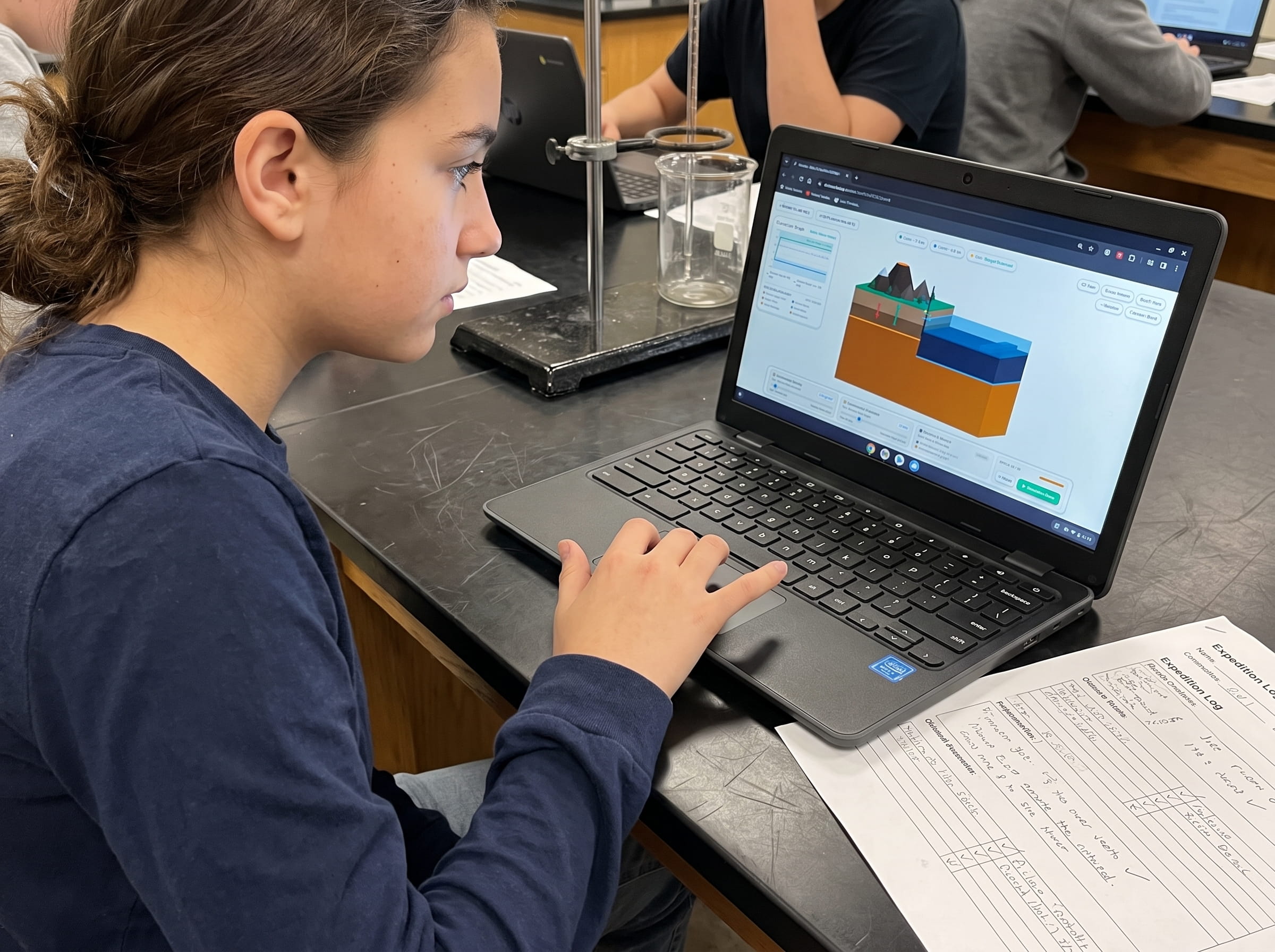
In Level 18 of Volcano Island, students monitor this surface displacement on a synchronized live trend graph. At Epoch 35, a Resurgent Dome Inflation Warning triggers: the ground swells upward by 12 meters, and geyser steam columns surge, signaling an impending containment crisis if venting is not maximized.
Level 18 Simulation: Continental Supervolcano Reservoir Lab
Command a 1,200 km3 subterranean rhyolitic magma reservoir beneath a continental plateau. Balance deep basaltic heat recharge with surface hydrothermal geyser venting to prevent a catastrophic VEI-8 super-eruption.
The Physics of VEI-8 Super-Eruptions: Containment vs. Rupture
What happens when containment fails? To understand how a peaceful caldera transforms into a super-eruption, middle school geoscientists must examine the mechanical balance of lithostatic rock containment.
A subterranean magma chamber is contained by the weight of the overlying rock column (lithostatic stress, σ_L) plus the tensile strength of the country rock (σ_T). The confining equation for rock rupture is defined by:
P_magma >= σ_L + σ_T
At typical supervolcano reservoir depths of 4 to 6 kilometers, the lithostatic confining pressure exerted by the overlying continental crust is approximately 80 to 90 Megapascals (MPa). As long as internal chamber pressure remains below 90 MPa, the roof rock remains structurally intact, and the reservoir stays safely trapped underground.
However, two compounding factors can drive magma overpressure above this 90 MPa threshold: continuous basaltic heat injection from below, and second boiling (volatile exsolution). As high-silica magma cools and crystallizes anhydrous minerals (quartz and feldspar), dissolved water cannot enter the crystal structures. It is expelled into the remaining melt, dramatically increasing gas vapor pressure.
When internal pressure breaches the 90 MPa limit, circular tensile ring fractures unzip through the entire 5-kilometer roof of the continent. The ceiling collapses downward into the chamber like a colossal stone piston, driving thousands of cubic kilometers of incandescent rhyolitic ash and boiling pumice outward in all directions. This is a VEI-8 super-eruption (Volcanic Explosivity Index 8), ejecting more than 1,000 cubic kilometers of magma, blanketing half a continent in toxic ash, and triggering a global volcanic winter lasting decades.
| Volcano & Eruption | Date | Ejected Volume (km3) | VEI Rating | Dominant Rock | Observed Impact | |
|---|---|---|---|---|---|---|
| Mount St. Helens (USA) | 1980 AD | 1.3 km3 | VEI 5 | Dacite | Lateral blast; regional ash across Washington and Idaho | |
| Mount Pinatubo (Philippines) | 1991 AD | 10 km3 | VEI 6 | Dacite | Stratospheric sulfur aerosol veil; global cooling of 0.5°C | |
| Mount Tambora (Indonesia) | 1815 AD | 50 km3 | VEI 7 | Trachyandesite | Year Without a Summer (1816); worldwide crop failures | hero |
| Yellowstone Lava Creek Tuff (USA) | 631,000 BP | 1,000 km3 | VEI 8 | Rhyolite | Colossal caldera collapse; ash blanketed entire North American continent | danger |
| Lake Toba (Sumatra, Indonesia) | 74,000 BP | 2,800 km3 | VEI 8 | Rhyolite | Planetary volcanic winter; near-extinction genetic bottleneck | danger |
Level 18 Simulation Guide: Containing the Super Chamber
In Level 18 of Volcano Island, players take control of a high-tech geoscientific observatory monitoring a 1,200 cubic kilometer rhyolitic magma reservoir deep beneath an active continental caldera plateau. Your mission is to maintain thermal equilibrium and keep internal chamber pressure below the 90 MPa lithostatic fracture point across 80 simulation epochs.
Three primary interactive controls govern the subterranean reservoir:
1. Basaltic Underplating Heat Recharge (Range: 10% to 100%, Default: 50%): Controls the rate at which hot mantle basalt pools beneath the continental crust, injecting thermal energy into the bottom of the crystal mush reservoir. Target optimal range: 42% to 48%.
2. Hydrothermal Venting Efficiency (Range: 0% to 100%, Default: 20%): Regulates the permeability of fault networks that feed surface geysers, hot springs, and fumaroles. Increasing venting allows superheated steam and volcanic gases to bleed off safely into the atmosphere, lowering chamber overpressure. Target optimal range: 68% to 75%.
3. Crystal Mush Solidification Ratio (Range: 30% to 80%, Default: 40%): Controls the proportion of interlocking mineral crystals within the reservoir. Higher crystal fractions damp thermal convection and trap magma in a viscous sponge state, while lower crystal fractions promote melt lens segregation. Target optimal range: 50% to 55%.
At the start of the simulation with default settings, Hydrothermal Venting is restricted to only 20%. Pressure rapidly climbs toward the 90 MPa danger zone. If students do not adjust the controls, the red pressure line spikes across the failure threshold, triggering an uncontained VEI-8 super-eruption that obliterates the diorama.
To clear Level 18, immediately increase Hydrothermal Venting Efficiency to 72% to activate surface geysers and bleed excess steam pressure. Next, throttle Basaltic Heat Recharge down to 45% to stabilize thermal input, and set Crystal Mush Solidification to 52% to keep the magma locked in a non-eruptible sponge matrix. The resurgent dome breathes safely at 72 MPa for all 80 epochs.
Student Laboratory Inquiry: Calculating Magma Volumes and Thermal Budgets
To connect the Level 18 interactive simulation with core middle school mathematics and physical science standards, students complete the following quantitative investigations in their Field Geologist Logbook:
Investigation 1: Comparing Eruption Volumes. A standard backyard swimming pool holds roughly 75,000 liters (0.000075 km3) of water. Mount St. Helens ejected approximately 1.3 km3 of rock. Mount Pinatubo ejected 10 km3. The Yellowstone Lava Creek eruption ejected 1,000 km3. Calculate how many Mount St. Helens eruptions equal one Yellowstone super-eruption (1,000 / 1.3 = approximately 769 times larger).
Investigation 2: The Thermal Safety Valve. If a hydrothermal geyser field releases 5 gigawatts (5,000,000,000 Joules per second) of heat, calculate how many Joules of thermal energy are safely vented to the atmosphere over a 24-hour period (5 x 10^9 J/s x 86,400 seconds = 4.32 x 10^14 Joules per day). Explain how this constant heat extraction prevents the underlying crystal mush from remelting into liquid magma.
Investigation 3: Lithostatic Pressure at Depth. Continental rock has an average density (ρ) of 2,700 kg/m3. Using the hydrostatic pressure formula P = ρ * g * h (where g = 9.8 m/s2 and h = 3,500 meters depth), calculate the lithostatic confining pressure exerted on the top of the magma reservoir in Megapascals (2,700 * 9.8 * 3,500 = 92.61 MPa). Explain why internal chamber pressure must remain below this value to avoid fracturing the continental roof.
Frequently Asked Questions About Supervolcanoes and Magma Reservoirs
Review critical scientific answers regarding supervolcano mechanics, magma chamber crystallization, and planetary eruption hazards below:
Is Yellowstone overdue for a super-eruption?
What is the difference between a caldera and a crater?
Could drilling a borehole into a supervolcano relieve the pressure safely?
How does Level 18 prepare students for Level 19 (Island Architect)?
Related Earth Science Units & Simulation Lab Resources
Continue your middle school Earth and Space science journey with these companion simulation guides:
Review crustal buoyancy in our crustal buoyancy isostasy simulation Level 1 guide.
Explore deep thermal circulation in our mantle convection tectonics simulation Level 2 guide.
Discover seafloor spreading in our seafloor spreading divergent boundary simulation Level 3 lab.
Investigate subduction abysses in our subduction zones deep trench simulation Level 4 article.
Explore subterranean magma generation in our flux melting magma chamber simulation Level 5 guide.
Study effusive basalt rivers in our shield volcano basaltic lava simulation Level 6 lab.
Examine viscous composite cones in our composite volcano silica viscosity simulation Level 7 guide.
Model supersonic gas decompression in our volcanic eruption plume gas simulation Level 8 guide.
Examine caldera collapses in our caldera collapse crater lake simulation Level 9 lab.
Explore mantle plumes in our hotspot island chain mantle plume simulation Level 10 guide.
Investigate locked transform faults in our locked fault elastic rebound simulation Level 11 guide.
Triangulate earthquake epicenters in our earthquake seismic waves triangulation simulation Level 12 guide.
Analyze open-ocean tsunami shoaling in our megathrust tsunami subduction simulation Level 13 guide.
Master circum-Pacific convergence networks in our ring of fire subduction arc simulation Level 14 guide.
Study primary ecological succession in our volcanic soil succession ash simulation Level 15 guide.
Model stratospheric sulfur aerosols in our volcanic winter sulfur aerosols simulation Level 16 guide.
Deploy sensor grids and forecast eruptions in our volcano monitoring early warning simulation Level 17 guide.
Review complete homeschool science options in our earth science homeschool curriculum guide.
Set up student accounts with zero student logins on our educator dashboard.
24 pages of printable isostatic buoyancy calculation tables, paleomagnetic zebra stripe rulers, and seismogram triangulation exercises designed for grades 3 to 8.
DOWNLOAD EXPEDITION LOGBOOK (PDF)Download Free Volcano Island Field Geologist Logbook (PDF)
24 pages of printable isostatic buoyancy calculation tables, paleomagnetic zebra stripe rulers, and seismogram triangulation exercises designed for grades 3 to 8.